 FMJ Facilities Management magazine providing industry-specific intelligence to FM and property professionals

 Aymen Fetouak MIH, Head of Professional Development at the Institute of Hospitality (IoH) with career advice for FMs thinking of working in hospitality
Facilities management professionals are already delivering hospitality every day. From front of house services and workplace experience to contract management and people leadership, FM roles increasingly sit at the point where buildings, services and people meet. What is changing is not the nature of the work, but how those skills are recognised and where they can lead.
Hospitality offers a useful lens for understanding this shift. Not as a separate industry, but as a professional discipline built around service culture, leadership and experience. For FM professionals thinking about progression, or for organisations looking to strengthen workplace performance, hospitality provides both structure and opportunity.
INSTITUTE OF HOSPITALITY
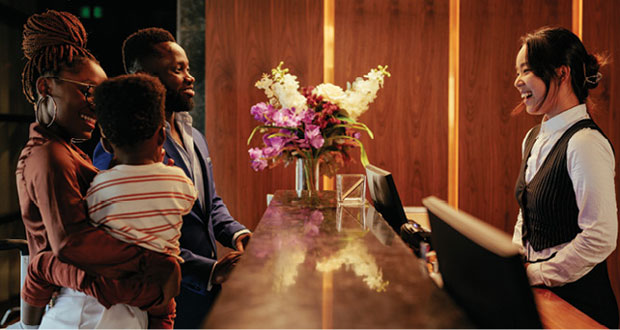
At the Institute of Hospitality, (IoH), we increasingly see careers moving between facilities management and hospitality, often without a clear dividing line. In practice, the connection is already strong. Front of house teams, catering, cleaning, security, workplace services and estates all contribute to how a space functions and how it feels. Together, they shape the daily experience of employees, visitors and clients, and in doing so influence how organisations are perceived.
Managing a multi-service contract in a large workplace often means leading diverse teams, maintaining service standards, responding to issues quickly, and balancing cost, quality and people expectations. These are core hospitality skills. What hospitality brings is a recognised professional framework that helps turn this experience into clearer career progression.
CAREER ROUTE
For individuals starting out in FM roles, hospitality can provide a credible and practical career route. Many are already using hospitality skills daily, even if they do not label them as such. Leading teams, handling complaints, responding calmly under pressure, setting standards and delivering consistent service are central to hospitality work. Professional recognition helps give those skills visibility and direction.
Careers in hospitality today are far broader than many people expect. They extend into leadership, people development, sustainability, wellbeing, operations and commercial decision making. For FM professionals, moving into hospitality is rarely a sideways step. In many cases, it opens access to roles with greater responsibility, clearer professional recognition and the ability to work across sectors or internationally.
LEARNINGS FOR FM LEADERS
There is also much that facilities management organisations can take from commercial hospitality. Hotels, restaurants and venues are built around experience. They understand that service culture, consistency and leadership behaviour matter every day, not just when something goes wrong. The same principles apply in workplaces. Employees may not be paying guests, but their expectations are shaped by the quality of service they experience elsewhere.
Workplace hospitality today goes well beyond reception desks or coffee provision. It is about how services are designed around people, how issues are handled when things do not go to plan, and how teams are supported to deliver well under pressure. Hospitality thinking brings focus to these areas, encouraging organisations to look beyond tasks and contracts and pay closer attention to the human experience.
Both facilities management and hospitality face similar challenges around attracting and retaining talent. Hospitality has long struggled with outdated perceptions, while FM can find it difficult to clearly explain the breadth of careers it offers. The opportunity lies in telling a more accurate story. Hospitality provides defined progression, recognised standards, mentoring and ongoing learning, all of which are increasingly important to people looking to build sustainable careers.
Professional recognition plays an important role here. When individuals can see a clear pathway from entry level roles through to senior leadership, supported by learning and peer networks, it changes how work is valued. This resonates strongly with FM professionals, where accountability, consistency and governance are already central.
HOSPITALITY BENEFITS
For employers, the benefits are practical. Teams with strong hospitality skills tend to manage change better, handle pressure more effectively and represent organisations with confidence. As workplaces continue to evolve, and expectations around wellbeing, inclusion and experience rise, these skills become even more valuable. By supporting clearer career routes between the two, both sectors can strengthen talent pipelines and raise standards.
 Hospitality is not an alternative to facilities management. It complements it. For individuals, it offers progression and professional recognition. For organisations, it strengthens experience, culture and performance. Framed in this way, hospitality becomes not a departure from FM, but a natural extension of it.