 FMJ Facilities Management magazine providing industry-specific intelligence to FM and property professionals

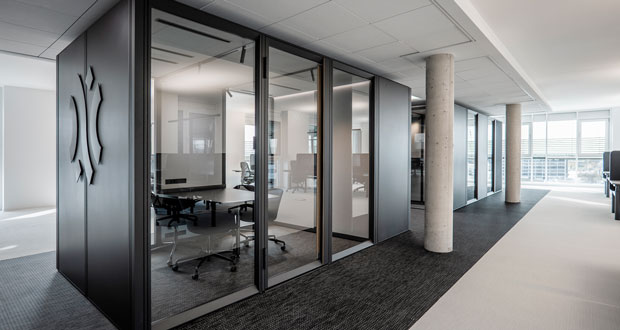
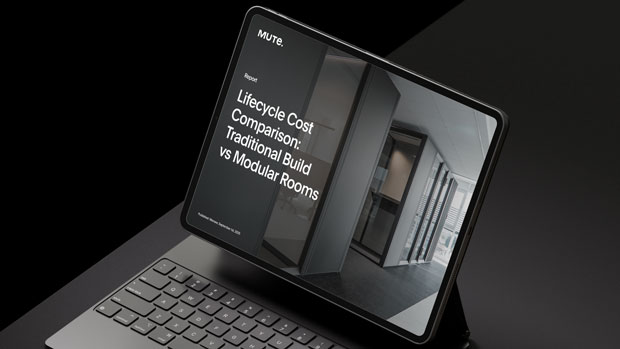
Mute, a leading innovator in adaptable office architecture, has commissioned cost consultancy EthosEQ, to conduct the first ever office adaptability study, to compare traditional site-built meeting rooms with Mute Modular meeting rooms across a 10-year lifecycle. Key areas of examination include cost, programme impact, flexibility and embodied carbon.
The analysis examined meeting rooms built using Mute Modular, Mute’s adaptable room-in-room system, or constructed using traditional methods such as plasterboard and glass partitions, conducted across 27 cities on three continents. Recognising that business needs change dynamically and that modern offices must adapt over time, the authors also analysed the costs of reconfigurations throughout the lease, which, in the case of modular units, are typically faster and cheaper.
“The key finding is that reuse dramatically improves both cost and carbon performance,” said Colin Wood, Partner at EthosEQ and author of the report.“Traditional rooms may be effectively single-use, whereas modular rooms retain their value and embodied carbon through multiple cycles of use. That shift is critical for organisations trying to reduce both financial waste and environmental impact. Based on market data published by JLL and assuming one configuration during the lease, we’ve calculated that the saving for the entire market would exceed €1 Billion for EMEA and €1.5 billion for the American market.”
It is an accepted industry truth that modular rooms can deliver substantial financial savings while significantly reducing environmental impact compared to traditionally built office rooms. However, the sheer scale of the saving, according to the authors’ calculation of €1 billion for occupiers across EMEA through the adoption of modular rooms instead of traditional construction over a lease term is startling.
This is a central finding; the day-one cost is a misleading metric: once change is introduced (which it almost always is), modular solutions deliver significant financial, operational and environmental advantages – this is essentially the tipping point for the saving.
Without exception, office space changes faster than buildings. Yet meeting rooms are still designed and delivered as permanent fixtures. The report challenges this mismatch and asks whether organisations should optimise for initial capital expenditure or long-term value over a typical lease term. Further finding include:
- Mute Modular rooms are around 10% cheaper on average on day one and up to 60% cheaper in high-cost cities such as London, Paris, and New York.
- Even minor layout changes make Mute Modular rooms more cost-efficient across all analysed markets, with average savings of 41%.
- Major reconfigurations significantly increase the cost of demolishing and rebuilding traditional rooms, making Mute Modular rooms far more cost-effective, with average savings exceeding 90% and even up to 150% in high-cost cities.
- At lease end, reinstatement costs for traditional rooms are more than three times higher than for modular alternative.
“The research shows that choosing between traditional and modular methods is no longer just a design decision, but a strategic one. Organisations must design for change, and adaptable solutions offers a way to reduce both financial risk and environmental impact. When the entire lifecycle cost is considered, our room-in-room system called Mute Modular can fundamentally reshape the economics of fit-out decisions across global markets,” said Szymon Rychlik, CEO of Mute.
Testing the theory
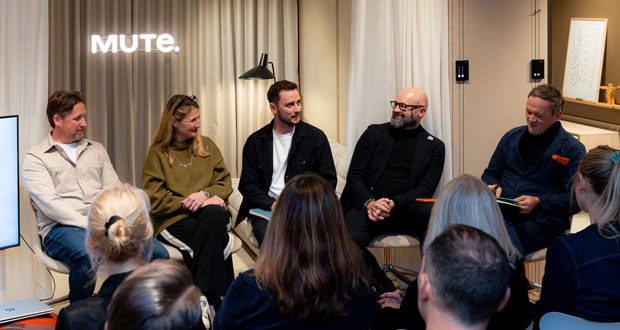 In order to challenge this further Mute hosted the launch of the report at its Clerkenwell showroom, for an objective panel discussion with three industry experts; Lydia Randall, Associate Director and Head of Sustainability at BDG architecture + design, Ross Ellmore, Senior Design Manager of Wates Fit Out and Gary Helm who is the Strategic Partnerships Lead at Mute. The session was chaired by David Taylor, Editor of New London Quarterly (the journal of New London Architecture), and provided the gathered audience with insights around the different stages of a refurbishment.
Cost and sustainability were central as the two main benefits of modular construction over traditional methods, with further key takeaways including:
Lifecycle beats capex: The strongest case for modular appears once change is introduced especially within a typical lease lifecycle.
Speed is strategic: Modular supports fast reconfiguration with minimal disruption, particularly in occupied space.
Circularity in practice: Reuse and relocatability shift meeting rooms from “disposable fit-out” to “retained asset”.
Not one-size-fits-all: Best results come from a hybrid strategy modular for agility, traditional for flagship/bespoke spaces.
Integration matters: The practical constraints are less about the rooms themselves and more about building services (notably sprinklers and air strategy) and early interdisciplinary coordination
The panel reinforced that modular meeting rooms should be evaluated through a lifecycle lens rather than day-one cost alone. As lease lengths shorten and workplace churn increases, the ability to relocate, reuse and reconfigure rooms significantly reduces capital exposure and end-of-lease liabilities, while enabling faster reconfiguration.
From a sustainability perspective, modular solutions support circular principles by minimising demolition, waste and embodied carbon across fit-out projects.
The consensus was that modular rooms will not replace traditional construction in every scenario, however it was agreed when deployed as part of a mixed strategy, modularity for meeting rooms are very much part of the formula for flexible solutions where lower-carbon assets that can be retained, relocated and redeployed across portfolios.
In this context, modular design is not simply a design choice, but a commercial and environmental one.