 FMJ Facilities Management magazine providing industry-specific intelligence to FM and property professionals

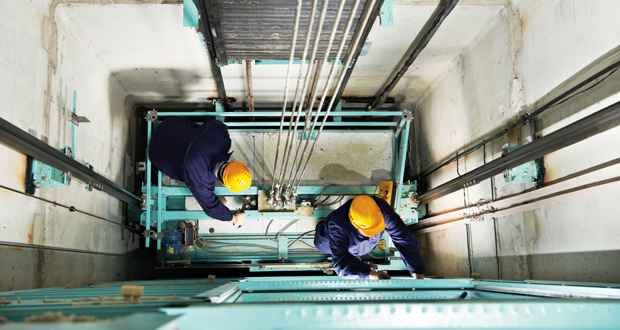
New research, commissioned by PEW Electrical, indicates that widespread uncertainty and fragmented record-keeping could be undermining lift fire safety compliance, weakening building fire strategies.
Last month, the Building Safety Regulator (BSR) became a standalone public body, separating from the Health and Safety Executive to provide a more dedicated oversight of building safety. The move forms part of a continuing shift toward more robust standards of fire and safety systems across the built environment.
Within this context, the research indicates that lift and escalator fire safety is emerging as a potential weak spot in building safety management, particularly in complex residential and mixed-use properties.
The research reveals significant uncertainty among facilities management professionals when it comes to navigating building safety compliance in practice. It found that almost half (44 per cent) of FMs say that they remain unclear about their obligations under the Building Safety Act and 56 per cent of FMs are unclear about documentation and accountability requirements. A further 46 per cent of FMs also admit that they are unaware of the BSR’s inspection requirements for lifts and escalators.
These concerns extend to information management. Nearly half (47 per cent) of FMs say that the industry suffers from fragmented and inconsistent record-keeping, raising questions about how reliably the “golden thread” of safety information is being maintained across lift supply chains.
When asked about the main challenges to ensuring fire safety compliance, the most frequently cited issues point primarily to delivery barriers, rather than a lack of intent. These include keeping up with evolving fire safety standards (29 per cent), coordinating multiple contractors and stakeholders (24 per cent), and budget pressures affecting the frequency and quality of inspections (18 per cent).
Technical complexity also plays a role, with almost one in five (17 per cent) highlighting the difficulty of retrofitting existing systems to meet modern fire safety requirements.
These challenges are compounded by the specialist nature of lift systems within wider fire strategies. While lifts play a critical role in evacuation planning and firefighter access, responsibility for design, maintenance, inspection and documentation is often distributed across multiple parties, increasing the risk of gaps in technical oversight and accountability.
However, despite the challenges, the findings suggest that facilities teams are actively maintaining lift systems and preparing estates for emergencies, even if compliance frameworks remain complex.
The research found that eight in 10 (80 per cent) conduct fire safety inspections and maintenance for lifts and escalators at least twice a year, three quarters (74 per cent) say that their fire evacuation plans are regularly practised with occupants, and nearly 85 per cent say they are confident in the effectiveness of their fire safety protocols during emergencies.
Commenting on the findings, Jason Clark, registered engineer and Chairman at PEW Electrical, said: “It’s clear that facilities managers are taking fire safety seriously: inspections are happening regularly, and there’s a strong focus on operational performance. But compliance today is about much more than maintenance alone. It’s about documentation, accountability, and making sure technical decisions are properly coordinated across the supply chain.
“Lifts sit at the centre of fire strategy, accessibility and emergency response. If those systems are managed in isolation, or if information is fragmented between contractors, it becomes very difficult for dutyholders to be confident that risks are being fully controlled.
“Adding to the challenge, facilities teams are under pressure to retrofit and demonstrate compliance in buildings that were never designed for modern evacuation strategies.”
With regulatory enforcement expected to increase, PEW Electrical warns that lift fire safety will remain a pressure point unless regulatory understanding, technical competence and supply chain coordination improve in parallel.
Clark added: “We know that the FM sector is committed to safety. But what’s needed now is greater alignment between operational activity and regulatory assurance – and this can’t be achieved if we continue to operate in silos.
“We need better collaboration between lift specialists, engineers, managing agents and suppliers if we are serious about supporting FMs, ensuring compliance, and genuinely strengthening safety outcomes.”
MRI Software is inviting facilities managers to share their opinions by taking part in its latest survey to uncover industry trends, priorities for the next 12 months, and the role of AI and IoT in shaping the future of FM.
The survey explores Agentic AI for autonomous operations, IoT-driven predictive maintenance, and sustainability as a core FM priority. These innovations are shaping smarter, more resilient workplaces, your input will help define how the industry embraces them.
By participating, you will receive a copy of the survey report outlining insights and best practices from your peers and innovation across the industry.
It only takes a few minutes to share your views. Complete the survey and enter MRI’s prize draw to win a £150 Amazon voucher!
Take the survey here.