 FMJ Facilities Management magazine providing industry-specific intelligence to FM and property professionals


 Anna Maclean, CEO and Co-Founder, SRE argues that approaching sustainable compliance with a design and performance mindset makes meeting green targets a performance opportunity
Almost every organisation in the UK faces a steep climb towards net zero. However, the impending cost is a source of concern, with recent research by energy supplier npower finding an overwhelming majority of large energy users (97 per cent) concerned about the cost of financing the low-carbon transition. Increasingly though, the evidence is showing that sustainability compliance doesn’t need to be treated solely as a cost centre but rather as a lever for performance, resilience and long-term asset value.
While energy pricing remains largely outside their influence, facilities managers have the tools to turn compliance and performance standards into cost-reduction and resilience strategies. The shift towards cleaner power and stricter ESG compliance, while challenging, also provides the framework for more efficient, future-proofed assets.
RETHINKING THE COST OF SUSTAINABILITY
The belief that sustainability always costs more is being challenged. Recent redevelopments show that targeted upgrades – improved building performance, more efficient HVAC systems, smarter building controls and the integration of renewables – can increase rental yields and occupancy rates while reducing long-term maintenance and energy costs.
SRE’s work on Cathedral Hill Industrial Estate in Guildford is a case in point. Working with Savills Investment Management, we advised on the redevelopment of the five-acre, 13-unit industrial site through a £10 million upgrade. The project achieved BREEAM ‘Excellent’ certification and EPC A/A+ ratings, becoming the UK’s first operational net zero industrial refurbishment.
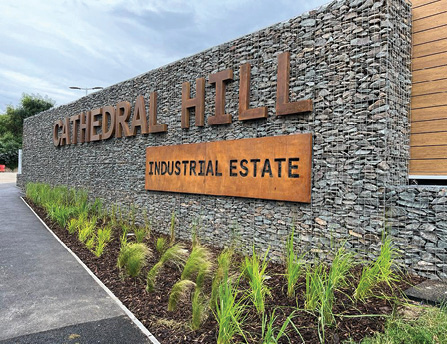 By prioritising the performance of the building envelope and integrating renewables, the refurbishment cut operational energy use to zero for some units, significantly reducing/eliminating running costs for occupiers. Tenant vacancies of 30 per cent were transformed into a waiting list for tenants, the rental value increased from £9.40 per sq. ft to £22.50 per sq. ft and the asset value more than tripled.
Cathedral Hill is just one example illustrating how sustainability, when applied strategically, can deliver operational efficiency and commercial advantage over and above the additional cost.
GETTING THE BASICS RIGHT
Efficiency starts with the building fabric. Applying the energy hierarchy – what’s often referred to as ‘lean, clean, green and seen’ – remains the most effective route to long-term savings.
The ‘lean’ stage focuses on eliminating waste and cutting energy demand before any new systems are added. That means making the building perform better through good design, maintenance and operation. This may range from airtight construction and passive heating or cooling measures to optimised controls and occupant behaviour. There’s no point in adding cost and embodied carbon in the form of technology if the building envelope itself isn’t operating at the highest possible level. Once the building is performing efficiently, the ‘clean’ stage focuses on delivering energy more effectively through high-efficiency plant and low-carbon systems and ‘green’, involves introducing renewable generation such as solar PV to meet the remaining demand.
At Cathedral Hill, these principles were applied through detailed building physics and performance modelling. Dynamic simulation modelling was utilised to optimise energy use, daylight and thermal comfort, ensuring each unit operated as efficiently as possible. This reduced demand before renewables were added, supporting the site’s net-zero outcome.
These principles are embedded in UK guidance including CIBSE TM54 on operational energy performance, BREEAM assessment standards and the UK Net Zero Carbon Buildings Standard. Following these standards and gaining certification helps facilities managers ensure that investment delivers measurable performance as well as benefiting marketability and, in turn, yields and value.
ENGAGING TENANTS FOR MUTUAL BENEFIT
While building performance and technology are important, so is building use. How people use a building – and how they’re encouraged to engage with it – can often have just as big an impact.
At Cathedral Hill, the estate’s rooftop solar array generates 0.5 MW of renewable electricity. Rather than the landlord owning that energy, the occupants do. This provides a direct incentive to minimise energy use which in effect reduces consumption, cuts operational costs and helps tenants strengthen their own sustainability reporting.
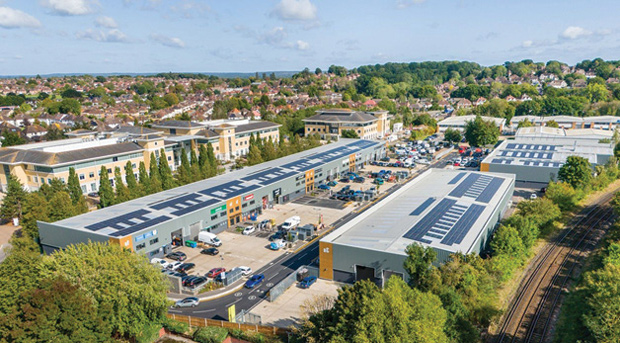
Live energy monitoring reinforces this behaviour by giving tenants real-time visibility of their usage and system performance. Some occupiers have achieved minimal or zero energy bills, while others have used the data to inform day-to-day operational changes. The result is a feedback loop that keeps efficiency and engagement aligned.
LOOKING BEYOND OPERATIONAL CARBON
Attention is turning to whole life carbon (WLC) – the total emissions from construction, operation and end-of-life. New BREEAM and planning requirements now mandate WLC assessments, aligning with national and local policies.
It’s a shift that demands a broader view of facilities management. Maintenance schedules, refurbishment strategies and material choices all influence embodied carbon and future cost. At Cathedral Hill, for example, we integrated WLC and operational energy assessments from the outset, as well as applying circular-economy principles that reused site materials such as stone masonry for landscaping. Beyond individual projects, thermal comfort assessments that use future weather data are becoming more common across the industry, ensuring buildings remain efficient and comfortable under changing climate conditions.
BUILDING CULTURE OVER TICKING BOXES
Certification remains important, but measurable performance is becoming the defining metric. The alignment of standards such as BREEAM and the UK Net Zero Carbon Buildings Standard is reinforcing consistency and accountability across the sector.
Each regulation and standard presents both challenges and opportunities. Energy audits, certification and carbon assessments generate insights that can be turned into operational savings and investment value. Facilities teams who act on this data are running buildings that are cheaper to operate, more resilient and more attractive to occupiers and investors.
Demand for efficient, low-carbon buildings already exceeds supply. The organisations that treat compliance as a design and performance toolkit – not a reporting exercise – are already seeing stronger returns.