 FMJ Facilities Management magazine providing industry-specific intelligence to FM and property professionals

SUSTAINABLE APPROACH
According to research from Savills, while London remains the global benchmark for high-spec, prestigious design, Manchester takes a more collaborative, community-driven, and cost-effective approach to design. This, along with working on refurbs rather than new builds results in a more sustainable design process, says Sanders.
“Refurbishment is quite a different game to a new build. When you’re designing a new build, the whole project is created in an imaginary way. But when you’re doing refurbishment, it is much more about being forensic.”
He explains that the first thing to work out is what has reached the end of its life. What needs replacing and what can be salvaged? Areas like floor finishes may be reused, or in the case of carpeting, the site tends to favour a stock carpet solution from local suppliers which can come in different colours to help reflect individual spaces or brands.
“Once we’ve worked out what we must replace”, adds Sanders, “we can begin to build up a palette. Stylistically, you might do something that’s perhaps more in vogue for a particular time, but it might be more trends driven and you can’t justify the impact on the planet. So, we say, ‘what is the smallest possible skip we can have? What’s the least we could throw away? Then what can we put in to enhance that space and give it a sense of identity?’”
Trends come and go and as Kenning explains, a lot of people assume a particular style, think open ceilings to lend an industrial aesthetic – are good design, because they’re seeing it everywhere. However, as Lang points out, resealing an exposed ceiling costs a lot to address and he says, simply redoing a colour scheme is a much less wasteful but impactful approach.
CREATING A COMMUNITY
Integral to the team’s ethos is creating a community feel. This is why tenants can arrange for their staff to have tours of the site prior to moving in to help them acclimatise to the change. Alongside this, on their first morning on the campus, occupants are offered a free breakfast or coffee and cake via the dedicated site app.
Also helping to foster a collegiate atmosphere was the decision to base reception staff in the same buildings rather than moving them around the campus, which results in a more comfortable and familial experience. And this welcome extends to introducing scents in each of the receptions with each building wafting a different aroma to visitors.
Explains Lang: “People just want to be recognised and offering that continuity is quite important in terms of creating those relationships.”
 An extremely important part of this engagement process is addressing the journey around the exterior of the campus, where the defining feature has traditionally been its huge-scale wayfinding totems. These were originally coloured orange but last year Jasper Sanders + Partners completed a design rebrand to each of the steel totems to reflect the individual character of each of the buildings they address.
Says Kenning: “We wanted the result to feel like a piece of landscape architecture, with each a separate experience, which is why we selected different colours so moving around you get a different vibe from each.”
Adds Sanders: “You can look through them, see under them and look down onto them from the offices so the whole experience is there to guide you around the entire campus.”
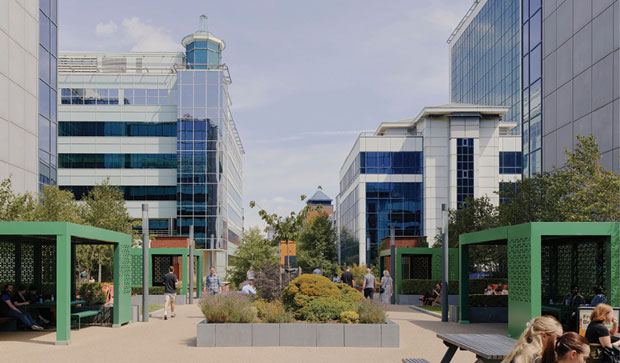
Beyond the design changes, the redesign is intended to promote health and wellbeing, with existing smoking shelters repurposed into open-air collaborative spaces, fostering social interactions and creativity. The team has also introduced diverse plant species on the shelter roofs and installed a herb garden right next to the catering facility for the chefs’ use.
FUTURE PLANS
While the Exchange Quay teams acknowledges that many employers are still grappling with staff’s demand for hybrid working hours, Lang observes that the pendulum may be swinging back to mandated presence in the office. He says: “People say you can do the same work from home, but what you can’t do is teach or learn. That’s becoming the biggest problem for many organisations.”
 Currently Jasper Sanders + Partners are working on a number of Cat B office fit-out designs for incoming tenants at Exchange Quay, including Renault Cars, located across the campus in Buildings 1, 3, 5 and 8.
Their remit, he explains, is to continue to physically connect these spaces, creating collaboration and community.
According to Kenning, because some offices almost became too relaxed in their nature post covid, she believes: “what we might see is that offices become slightly more tailored to a company’s specific business model”. But the ideal both property manager and designers agree is maintaining that human centric approach.
Says Sanders: “Design with people first and think about how people use space. Our job is to open their minds up to the possibilities.”