 FMJ Facilities Management magazine providing industry-specific intelligence to FM and property professionals

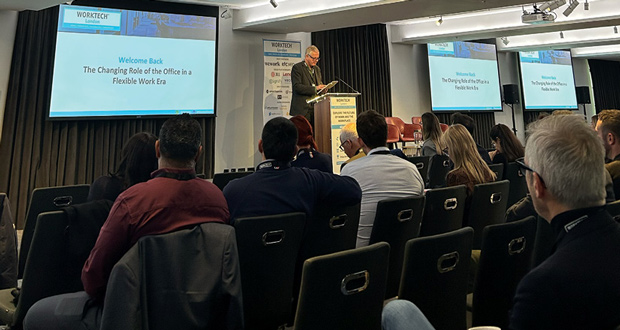
WORKTECH London returned on the 18-19 November with the aim to push the boundaries of how we think about work, workplace, and workforce transformation
This year’s event took place across two days, the 17th being a series of tours and talks with the conference programme commencing on the 18th from London’s County Hall with a packed agenda of keynote talks and live debates, bringing innovative ideas and inspiration to the workplace community.
THE FUTURE OF WORK
The first theme of the day was ‘Navigating the Future of Work: What’s Next and How to Prepare’. This discussed the key trends across people, place and technology that are shaping the next decade of work, from AI and autonomy to new models of leadership, decision-making and value creation.
Throughout this section of the conference, speakers emphasised the ‘reimagining’ of work, space and culture, due to accelerating technology and evolving ideas about the role of the workplace. They all expressed how future workplace strategies should focus on adaptability.
Next, Philip Ross, CEO and Founder of Cordless Group and UnGroup, shared inspiring examples from around the world on how AI is an enabler of this process. From JP Morgan’s AI integration at their new headquarters on Park Avenue in New York City to Booking.com’s tech-enabled offices in Europe and their use of Cisco and new Italian platform Blue GPS, the consensus was clear: those who invest in flexibility, will technologically, organisationally and culturally be best equipped to navigate what comes next.
THE FLEXIBLE WORK ERA
The second theme of the event was ‘The Changing Role of the Office in a Flexible Work Era’ which looked at reimagining physical space to support innovation, connection, and culture. The office is being repositioned as a space that people choose to use, not one they’re told to. The discussions under this theme centred around designing offices that earn the commute in a working world where flexibility is now ingrained, instead of debating the merits of return-to-office mandates.
Speakers, including Tim Fendley CEO and Founder of Applied Information Group, Dan Honour Enterprise Sales Manager of Vercos and WorkTech Academy, along with a case study from AIS and Revolut, focused on showcasing environments that prioritise intentionality: spaces built for connection, creativity and collaboration. All these speakers shared workplace strategies and technologies that combine spatial intelligence, design experimentation and a culture-first approach. As emphasised by Dan Honour, understanding real-time workforce behaviour is essential, with relevant, actionable data being used by organisations to shape smarter workplace strategies that balance space efficiency with employee experience.
These sessions demonstrated that in a flexible work era, the office still matters but its purpose is changing. It is shifting from a fixed asset to a continuously evolving space, adapting to the needs of those using the space.
PEOPLE CENTRED WORKSPACES
Next, the discussion theme turned to ‘People Centred Workplaces: Cultivating Culture and Engagement’. This section of the day explored the post pandemic impact of work, space, buildings and the effects on employee and company productivity, as well as the impact on wellbeing, behaviour and culture. How can companies make the office an attractive proposition to employees who now have more choice in how and where they work?
With engagement and wellbeing now key organisational priorities, the speakers, including Chris Higgins and James Fretton of GSK, who were followed by a fireside chat consisting of industry experts from XY Sense, Phase 4, Sainsbury’s, and Capgemini, explored strategies for creating inclusive, high-trust environments that nurture performance and psychological safety. The case studies highlighted the power of co-creation, behavioural insights and employee listening as the means of shaping spaces that reflect how people really work. From neuro-inclusive design to community building initiatives, the prevailing message was that thriving workplaces are built around human needs first, with space, policy, and technology acting as enablers.
CONNECTED WORKPLACE
Two separate streams in the late afternoon explored the connected workplace: ‘where people, data & tech converge’ and ‘meeting evolving workforce expectations’. For the latter, Oliver Patrick, a leading expert in lifestyle management on embedding health and performance science into the built environment outlined the five areas essential to wellbeing, which are movement, nutrition, recovery, environment and mindset. This was followed by a panel session on how HR and Corporate Real Estate teams can collaborate to meet changing workplace practices in the era of hybrid working. With data and technology reshaping how, where, and why we work, the panel agreed data insights can help HR and CRE make the right decisions that ensure a real estate strategy is aligned with a people and capabilities strategy.
CONCLUSION
As WORKTECH London made clear, the workplace is no longer a static backdrop but a constantly evolving platform in how organisations connect and create. As technology, employee expectations and business priorities continue to intersect, rethinking old norms and designing workplaces with purpose and humanity at their core is key.