 FMJ Facilities Management magazine providing industry-specific intelligence to FM and property professionals

LIGHTING AND WELLBEING
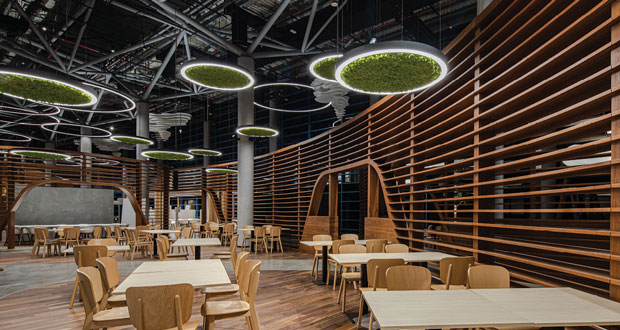
Lighting, too, is a critical component of wellbeing. Good lighting enhances alertness, reduces eye strain, and supports circadian rhythms, while poor lighting can lead to discomfort and decreased motivation. The challenge for designers is to create spaces that balance visual and acoustic comfort without compromising aesthetics or functionality. This is where acoustic lighting comes in – a solution that elegantly combines two essential functions: illumination and sound mitigation.
Acoustic lighting fixtures are designed with sound-absorbing materials and installed in the space between the desk and ceiling, an area often underutilised but crucial for controlling reverberation. By targeting this zone, acoustic lighting addresses the problem at its source, reducing echo and improving speech intelligibility while providing high-quality light.
The benefits of acoustic lighting are manifold. First, it makes efficient use of space, integrating acoustic treatment into lighting fixtures rather than requiring separate panels or baffles. This dual-purpose approach not only saves space but also reduces costs, as companies can achieve two objectives – lighting and noise control – with a single investment.
Second, acoustic lighting improves the overall acoustic environment, reducing distractions and enhancing speech privacy. This has a direct impact on cognitive performance, supporting critical listening, memory retention, and effective communication.
Third, by creating a more comfortable and less stressful environment, acoustic lighting contributes to employee wellbeing, which in turn drives productivity and job satisfaction. In short, it is a holistic solution that aligns with the growing emphasis on wellness in workplace design.
LIGHTING QUALITY AND NOISE CONTROL
Acoustic lighting is particularly suitable for spaces where both lighting quality and noise control are priorities. Open-plan offices benefit greatly, as these environments are most vulnerable to conversational distractions and reverberation. Meeting rooms and video conferencing spaces also require excellent acoustic conditions to ensure clear communication, especially as hybrid work models make virtual collaboration more common.
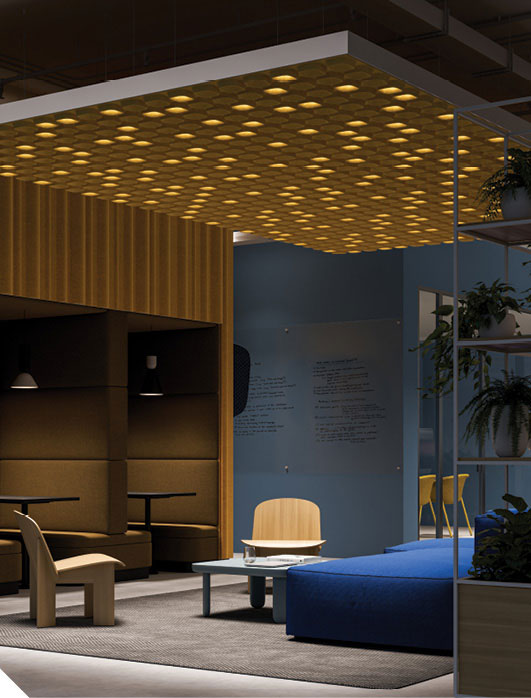
Breakout areas, designed for informal meetings or focused work, can also be enhanced with acoustic lighting, creating zones that feel inviting and functional. Case studies demonstrate that combining acoustic lighting with other sound-absorbing finishes, such as carpets and mineral fibre ceiling tiles or other acoustic ceiling types, can significantly reduce reverberation times, meeting recommended standards for different room types. For example, a typical meeting room with carpet but with an exposed concrete ceiling might start with a reverberation time of one second, far above the recommended 0.4 to 0.6 seconds. Introducing acoustic lighting fixtures can bring this down to acceptable levels, improving both comfort and clarity.
 DESIGNING FOR WELLBEING
As workplaces continue to evolve, the importance of designing for wellbeing cannot be overstated. Noise and poor lighting are not just minor irritants; they are factors that influence mood, health, and performance daily. Organisations that invest in solutions like acoustic lighting demonstrate a commitment to creating environments where people can thrive.
By addressing two critical aspects of comfort in one elegant product, acoustic lighting represents a forward-thinking approach to workplace design – one that acknowledges the complex interplay between physical space, human behaviour, and organisational success. In an era where talent retention and productivity are paramount, such innovations are not just desirable; they are essential. The future of work will be shaped by environments that prioritise wellbeing, and acoustic lighting is poised to play a central role in that transformation.