 FMJ Facilities Management magazine providing industry-specific intelligence to FM and property professionals

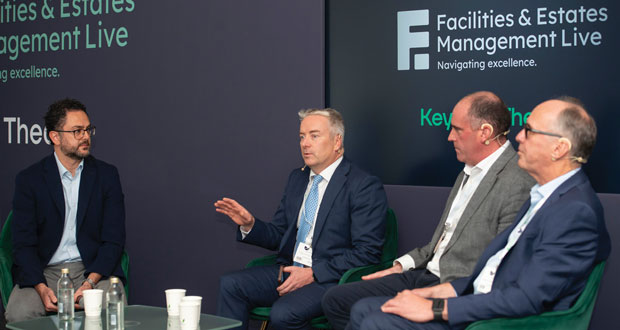
Piers Zangana chaired a discussion at Facilities & Estates Management Live on the provision of foodservices in an ever-changing workplace
PARTICIPANTS
• Piers Zangana, Susa Comms
• Angus Brydon, MD at catering specialists BM Caterers
• David Crew, Global Operations Director at Hogan Lovells
• Julian Fris, Founder & CEO Neller Davies
Helping to set the scene, Piers Zangana asked David Crew to describe the current catering arrangement within his organisation. Crew said that you can’t ignore the fact that the last five years have changed the way that we utilise offices. This requires he said, organisations to be quite nimble compared to before the pandemic when catering was far more of a vanilla offering.
He explained: “I think now we need to be far more flexible with our head count and one of the things that we’ve seen is, not only do we want to get people back into the office we need to anchor them there by helping them celebrate and collaborate.
“One of the things we’re noticing is that we’re holding a lot more events than we did before, and that has really changed the landscape regarding the catering offer that we provide in our offices.”
For his part Angus Brydon agreed that catering is now more of an emotionally led offering which demands that as the catering partner, his priority is to innovate to serve the workforce to the best level he can while also doing the right thing for the client.
OUTSOURCING CONSIDERATIONS
With outsourced FM now making up two-thirds of the FM market, collaboration between suppliers and clients isn’t just a side show, said Zangana, it’s how most FM gets done. He asked the panel: “In your experience, what are the key conditions for genuine collaboration, and how do they change outcomes compared to more transactional contracts?”
All the panel agreed that while clients want to see value for money, to ensure the best service and food quality, an essential part of the mix requires a partnership relationship between supplier and client.
“We’ve seen organisations experiment with the insourcing/outsourcing hybrid” said Zangana, “is there a situation where either works best?”
From the client perspective Crew explained Hogan Lovells doesn’t outsource its entire facilities operation – as the aim is to benefit from the ‘best of breed of a mix of suppliers’ combined with some in-house provision.
When it comes to catering, though he said: “We’re not the experts so we rely on BM to give us the leading edge, ensure that we’re compliant, keep things seasonal, fresh and that people are interested in the offerings that we provide.”
According to Brydon – ultimately, the supplier is there to serve the clients and to make sure that they offer the best service and delivery, so whether foodservices are outsourced or in-house the aim is to ensure that everyone works as one team.
Places where insourcing is a preferred approach may depend on the way the original system was set up, advised Catering & FM consultant Julian Fris. For instance, he’s worked on bringing catering contracts back in-house for NHS hospitals that have experienced poor service delivery from their contractors. But in most cases, he added there are a good cross section of companies in the market who can deliver the services people want and clients must also keep in mind that, “if it doesn’t work out, you’ve always got a get out clause”.
CATERING FRAMEWORKS
Procurement frameworks are a favoured way to procure services and supplies for larger organisations (especially in the public sector). “When this works well,” asked Zangana, “do they enable clients to access good practice more quickly, avoid reinventing the wheel and help build innovation at some pace and speed?”
Crew revealed he was wary of framework contracts across all FM services as he believes, “you’re not buying widgets, you’re buying professionalism, and what you get in one location is not what you’re going to get somewhere else.”
Brydon explained that with many catering contracts you’ve got to be on the framework to have the opportunity of going to tender, but once the vetting part’s been done and the credentials all stack – with catering being an emotionally led-service the people that are actually going to deliver the contract need to make sure they meet the people they’re going to be working with to ensure the relationship is a success.
Fris explained that frameworks are not for every scenario: “I think a different process particularly in quite difficult situations, requires more of a filtration exercise to get down to the people you actually want to talk to and the frameworks can be a little bit blind to that because you would just get somebody who can tick boxes as opposed to a partnership where your culture aligns.”