 FMJ Facilities Management magazine providing industry-specific intelligence to FM and property professionals

 Alan Cooper, Founder of Waste to Wonder Worldwide awarded an OBE for services to charity and sustainability on moving from waste management compliance to resource stewardship
For over two decades, I have worked closely with FM professionals, workplace leaders, and property teams, helping organisations rethink how they manage surplus assets during workplace change. The OBE recognises a career dedicated not only to sustainability, but to proving that operational decisions made in buildings can create measurable environmental and social impact across the world.
CHALLENGING THE PERCEPTION OF WASTE
Waste to Wonder Worldwide was founded on a simple principle – challenge the perception of waste. In the early 2000s, office furniture and equipment were typically viewed as disposable once organisations relocated, downsized, or refurbished. The default outcome was recycling at best, landfill at worst. I believed there was another option.
By working with FM teams and workplace partners, Waste to Wonder Worldwide developed a model that enabled redundant office furniture and equipment to be ethically reused through structured redistribution programmes. What began as a niche service has grown into one of the world’s largest ethical reuse programmes.
To date, the organisation has redistributed more than £50 million worth of furniture and equipment, equipped over 1,700 schools and charities, and supported initiatives across 50 countries, including the UK.
For FM professionals, this shift represents more than good environmental practice. It represents a move towards asset lifecycle thinking, extending product life, reducing embodied carbon and generating measurable social value.
FM AS A DRIVER OF SOCIAL AND ENVIRONMENTAL IMPACT
Facilities management sits at a unique intersection of operational delivery, procurement, sustainability and workplace strategy. Decisions made during office clearances, relocations and refurbishments directly influence waste generation, carbon emissions, and resource use.
Increasingly, FM leaders are recognising that surplus assets should be viewed as resources rather than liabilities.
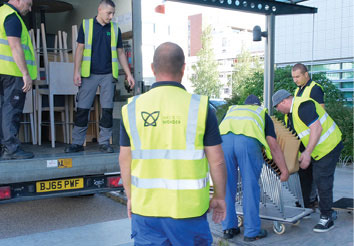 Ethical reuse offers multiple benefits aligned with modern FM priorities:
- Reduction of Scope 3 supply chain emissions.
- Contribution to circular economy strategies.
- Demonstrable ESG and social value outcomes.
- Cost-effective alternatives to traditional disposal routes.
- Alignment with Net Zero and corporate sustainability commitments.
I have always argued that ESG should be discussed in reverse order, because without strategic governance, environmental and social commitments cannot be delivered consistently. Governance lies at the heart of changing aspirational aims into real deeds.
For many organisations, workplace transformation is now one of the most carbon-intensive operational activities. Replacing large volumes of furniture and equipment creates significant upstream manufacturing emissions. Extending the life of existing assets through reuse can dramatically reduce total lifecycle carbon impact.
SHIFT FROM WASTE MANAGEMENT TO RESOURCE STEWARDSHIP
The FM sector is undergoing a shift, from managing waste streams to managing resource value. This requires early engagement in project planning, collaboration across supply chains, and clear sustainability objectives embedded within project briefs. Lead times are critical. Where FM teams are engaged early, reuse outcomes increase significantly. Where decisions are left until lease end or project completion, options become limited and disposal costs increase.
This transition also reflects a wider cultural shift. Sustainability is no longer viewed as an additional layer of responsibility; it is becoming central to operational excellence, brand reputation, and risk management.
LOOKING AHEAD
I believe the next phase of sustainability will be defined by how organisations use their operational decisions to influence global outcomes.
Facilities management will play a central role in this shift. In the coming years, organisations will increasingly measure success not just by financial performance, but by the positive outcomes they create through everyday operational decisions. FM teams are uniquely placed to influence this, because they manage the physical environments where those decisions become reality.
As regulatory frameworks evolve and reporting expectations increase, FM will become even more critical in delivering measurable sustainability performance. From asset management to supplier selection, FM professionals will continue to shape how organisations deliver on Net Zero, circular economy commitments, and social value targets.
RECOGNITION OF A COLLECTIVE MOVEMENT
For me, the OBE represents recognition not just of one organisation, but of a wider shift in how businesses approach surplus, sustainability, and social responsibility.
Progress has been made possible through collaboration, with FM professionals, customers, workplace strategists, and partners willing to challenge traditional disposal models.
This recognition belongs to everyone who has chosen to do things differently. Real impact is never created by one organisation alone. It is created when sectors move together.
NOTHING IS GREAT EXCEPT GOOD
I often reflect on a Latin phrase that has guided my work: Nil magnum nisi bonum – nothing is great except good. For the FM sector, the message is simple. The decisions made about buildings, assets, and workplace environments do not just affect organisations. They affect supply chains, communities, and future generations.
As sustainability expectations continue to rise, FM professionals are not just managing buildings. They are shaping environmental outcomes, social progress, and the future of responsible business.
In association with www.wastetowonder.com.