 FMJ Facilities Management magazine providing industry-specific intelligence to FM and property professionals

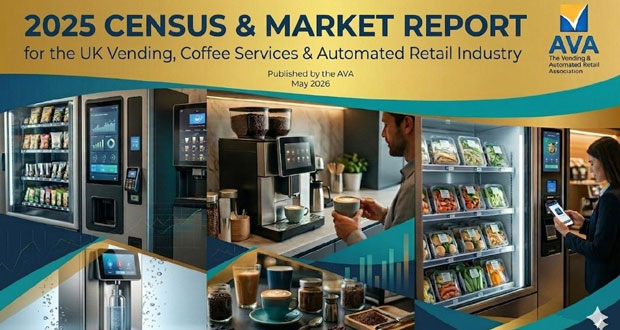
The UK’s vending, coffee services and automated retail industry generated £3.78 billion in total revenue in 2025, according to the AVA’s 2025 Census & Market Report.
The figure, up 3.3 per cent on 2024, places the industry 5 per cent above its pre-Covid 2019 baseline, confirming a recovery that is not just complete, but surpassing the UK economy’s rate of growth with just 1.4 per cent reported. At £3.78 billion, the sector is now larger than both the UK’s entire biomass and hydroelectric energy generation industries.
Traditional Vending and Office Coffee Service (OCS) combined, delivered £3.13 billion in total revenue, with product revenue growing 6.8 per cent year-on-year to £2.28 billion, now almost 10 per cent above pre-pandemic levels.
Some of the stand-out category growth figures (year-on-year) include:
- Cold beverage revenues rose 15.4 per cent
- Food revenues grew 12.2 per cent
- Snack revenues increased 5.7 per cent
- Hot beverage revenues grew 4.1 per cent
Operators reported an average revenue increase of 7 per cent in 2025, with 90 per cent forecasting further growth in 2026.
The fastest-growing format in the entire sector is the standalone smart fridge, which grew by approximately 50 per cent in a single year to reach 2,850 total units. Smart fridges are a cashless-by-design technology that opens via bank card or mobile app and automatically charge consumers for whatever they remove using RFID tags, weight sensors and cameras. It is particularly popular in hybrid working environments, where staffed catering is no longer economically viable. Micro-markets also reached 785 installations, up 8 per cent year-on-year, demonstrating a move towards the most flexible and convenient formats, while still maintaining high quality.
Cashless payment technology is now fitted to 95 per cent (up 5 per cent compared to 2024) of all pay-vend machines in the UK, with around 30 per cent of the pay-vend estate now accepting no cash at all. Of transactions on enabled machines, 84 per cent are cashless, with 62 per cent completed via mobile phone, up from just 8 per cent in 2017. The shift away from contact chip-and-PIN has been equally dramatic, falling from 47 per cent of cashless transactions in 2017 to just 3 per cent today. Crucially, cashless customers spend on average 100 per cent more per transaction than those paying with coins, a figure that has doubled since 2018 and makes the commercial case for cashless investment unambiguous.
The Coffee-to-Go segment generated £645 million in product revenue from a base of 33,200 machines (up 8 per cent annually). The scale of the price premium is striking, the average Coffee-to-Go serve costs £2.89, compared to just £0.56 for a traditional vending machine hot drink – 5.2 times higher. Quality is rising across the board, with bean-to-cup technology continuing to grow its share of the market within traditional vending. Over 40 per cent of new tabletop machines are now fitted with fresh liquid milk modules for barista-style drinks.
David Llewellyn, Chief Executive of the AVA, commented: “The 2025 Census confirms an industry that has not simply recovered from Covid, it’s transformed in the process. This industry has always been underestimated, and while the rest of retail has been struggling with customer demands, vending and automated retail has been quietly growing by investing in technology that actually aids customer experience, raising its game on quality, and finding new opportunities to shine.
“All the while we face potentially catastrophic legislation change from the governments proposed ban on the sale of energy drinks to under-16s, potentially creating a big dent thousands of operator’s revenues. All AVA members currently adhere to voluntary guidelines not to sell these drinks in publicly accessible machines, meaning no young people are able to access high caffeine options. We urge the government to reconsider this action and continue supporting this positive growth industry in the UK.”
The report can be accessed by AVA members on the website.