 FMJ Facilities Management magazine providing industry-specific intelligence to FM and property professionals

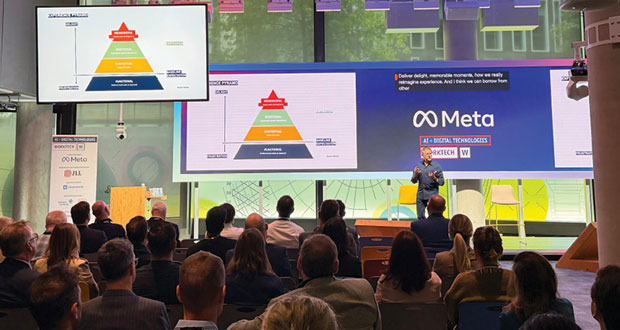
 As AI becomes embedded in workplace strategy, leaders gathered at WORKTECH AI + Digital Technologies to discuss the opportunities, challenges and responsibilities that come with an AI-powered future. Madeleine Ford reports
WORKTECH AI and Digital Technologies London is the new flagship event in the WORKTECH series. While discussions ranged from generative AI and digital twins to smart buildings and workplace analytics, a common theme emerged throughout the day: technology’s greatest value lies not in replacing people, but in empowering them to make better, faster and more informed decisions. Digital transformation begins and ends with people.
THE INTELLIGENT WORKPLACE
The morning sessions were opened by Rob Garlick, AI, Work & Pro-Human Leadership Professor, who discussed why the future of work will be decided by leadership choices, not technology.
A recent King’s College survey showed that only 24 per cent of people thought that AI was positive for humanity. “The numbers are showing to be more negative over time as the capability is rising,” with AI advancements happening over 30 times faster than previous industrial revolutions. This speed and the fact that in 2024 ChatGPT surpassed human capabilities in a number of areas, is leading to concerns about job displacement. Garlick posed the question: how do we make sure we’re augmenting people and not replacing them? He stated that safety nets need to be put in place. Financial safety nets are essential, including the potential introduction of Universal Basic Income. Unions should also not be overlooked, as they play an important role in giving workers a voice during the transition to AI.
Secondly, and most importantly according to Garlick, is skilling people to go from old jobs to new and ensuring companies invest in training. He even went as far as to suggest democratising jobs by moving to shorter weeks. Implementing this change would have to be a societal decision of putting general protection in place. Garlick concluded the framework for managing AI’s impact is the 3Bs- better jobs, better skills, better society.
HUMAN EXPERIENCE & DIGITAL ADOPTION
While much of the day’s discussion focused on the rapid evolution of AI, speakers repeatedly emphasised that its success will ultimately be measured by its impact on people. Rather than deploying technology for technology’s sake, organisations must ensure digital tools enhance employee experience, simplify day-to-day tasks and support more effective ways of working.
Harish Krishna, Director of Engineering at Meta, explored what it means to rethink the workplace in the age of AI. Reflecting on the shift to hybrid working, he suggested that the conversation should move beyond whether employees are in the office or at home and instead focus on how intelligent the workplace itself has become.
Krishna described the vision of an adaptive workplace – one that responds dynamically to employees’ needs through connected data, AI and digital tools. By understanding work patterns, team interactions and workplace demand, organisations can create environments that automatically recommend workspaces, support collaboration and remove friction from the working day. “I’m passionate about building meaningful experiences in the physical space using the right combination of digital software, data and AI,” he said, adding that achieving this requires a unified technology ecosystem rather than disconnected digital solutions.
He also challenged organisations to think carefully about where AI can deliver the greatest value, suggesting that the most effective workplaces will combine autonomous AI with human judgement, rather than replacing one with the other.
ORGANISATIONAL CHANGE, TRUST & LEADERSHIP IN THE DIGITAL AGE
While technological innovation often attracts the headlines, many speakers argued that the biggest challenge facing organisations is cultural rather than technical. An expert panel titled ‘Who Owns the AI Way of Working?’ explored organisational change and highlighted the reality that AI adoption is ultimately a transformation programme, requiring new ways of working, new skills, and greater collaboration across departments. Organisations must focus on reskilling and digital literacy, ensuring employees have the confidence and knowledge to work alongside emerging technologies.
Several sessions focused on leadership’s evolving role in an AI-driven world. Rather than simply approving technology investments, leaders are increasingly responsible for shaping organisational culture, defining governance structures and helping employees navigate uncertainty. The quality of leadership decisions, speakers argued, will ultimately determine whether AI delivers abundance or disruption.
CONCLUSION
WORKTECH AI and Digital Technologies London demonstrated that successful digital transformation depends on balancing innovation with human needs – working hand in hand with trust and human-centred design. As organisations continue to navigate rapid change, the challenge will be creating workplaces that are not only smarter and more efficient, but also more trusted, inclusive and responsive. The future workplace will not be defined by how much technology it contains, but by how intelligently that technology is used.