 FMJ Facilities Management magazine providing industry-specific intelligence to FM and property professionals

 Front-of-house could be your most underused tool for recruitment and retention, making the office a destination, not just an obligation says Cheryl-Anne Cooper, Chief Daymaker at On Verve
As businesses grapple with bringing their employees into the workplace, they need to create a sense of community and belonging that reflects organisational culture, something remote work just can’t offer. Front-of-house (FOH) teams may be the most underused resource for turning the office into a distinctive destination, not an obligation. Guest services go beyond simple transactions, creating moments that matter, developing genuine connections, and transforming how people experience their workplaces.
THE OFFICE IS AN ECOSYSTEM
Consider the office as a living ecosystem: every department is a vital organ, facilities teams provide circulation, and FOH professionals are the connective tissue, understanding how people work, communicate, and interact. This awareness enables them to smoothly support employees throughout their day, creating environments where they feel understood, supported, and appreciated.
Guest services teams do far more than order stationery and sign for packages. They coordinate travel, problem-solve throughout the day, and handle supplier relationships, all while reading each person that comes through the door.
In spaces increasingly driven by screens, FOH teams prioritise face-to-face needs. They know who appreciates a warm welcome in the morning, who might want some space, and who might need someone to listen when their day has been difficult. This emotional intelligence, built on countless daily interactions, creates the basis for genuine connection.
REDUCING STRESS AND IMPROVING WELLBEING
Recruitment and retention are often thought of in large-scale strategies, but the day-to-day environments candidates enter are a hugely significant factor. Two-thirds of employees are stressed at work, and 20 per cent cite workplace culture as a cause. Their health and wellbeing need support through action.
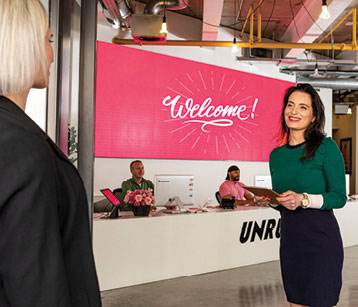 The first step in creating a healthy workplace is identifying problems colleagues face and taking that weight off them. FOH teams can do that with big and small gestures, which reduce stress and give each individual the respect they deserve.
These moments might seem small, but they show everyone that their needs matter. For example, if someone has forgotten their lip balm, a receptionist could pop out to get them a replacement. Or, if an employee has forgotten their reading glasses and is getting headaches, a simple solution is to purchase a few low-cost spare reading glasses to keep at reception, so no one faces that pesky headache again.
Larger-scale changes could involve adapting spaces to prioritise health. Offices are often far from parks and greenery, but access to green spaces improves mood, creativity, and cognitive function. Guest service teams could install flower boxes, herb gardens, or even work with local experts to develop wildflower gardens that provide much-needed calming spaces amidst dense city spaces.
No matter how big or how small, if a FOH colleague can fulfil someone’s request, they will. These changes don’t just improve someone’s day; they help maintain healthy workplace cultures.
BUILDING COLLABORATIVE PARTNERSHIPS
The operational centrality of guest services means that they deeply understand workplace patterns, pain points, and what can change them. We call our FOH teams DayMakers because they aim to be the reason why someone’s day gets a little bit better, brighter, and easier. When they have developed that deep understanding of a customer’s culture and people, they become the heartbeat of the office.
Understanding these spaces so intently has even led to members of our own team transitioning into roles at our customer sites. That is a testament to how strong guest service teams’ relationships with customers can become. Their understanding makes them brilliant new team members. This gives customers a proven talent pool within their environment, reducing the time, cost and uncertainty typically associated with recruitment.
The strength of these relationships highlights the value of human presence and connection. Research confirms that customers judge the experience of dealing with a person as superior to dealing with artificial intelligence.
Building relationships with people who care about your individual needs every day can be the difference between feeling like you’ve been forced back to the office and feeling like you’ve arrived somewhere that values your presence.
CREATING SPACES WITH EMPATHY
When employees feel unacknowledged in the workplace, they are likely to seek new opportunities. Research from Deloitte found that a toxic corporate culture, where workers may feel disrespected or may witness unethical behaviour, is 10.4 times more powerful than compensation in predicting an organisation’s attrition rates.
For businesses asking employees to return on-site more frequently, human infrastructure matters as much as physical infrastructure. To recruit and maintain colleagues, you need empathy and understanding. Receptionists, front-of-house teams, and guest services create those environments where employees feel valued.
The commute will always cost time and money, but when employees arrive to find someone who knows them and makes their working day just that bit easier and brighter, the office becomes a competitive advantage in building and maintaining exceptional teams.