 FMJ Facilities Management magazine providing industry-specific intelligence to FM and property professionals

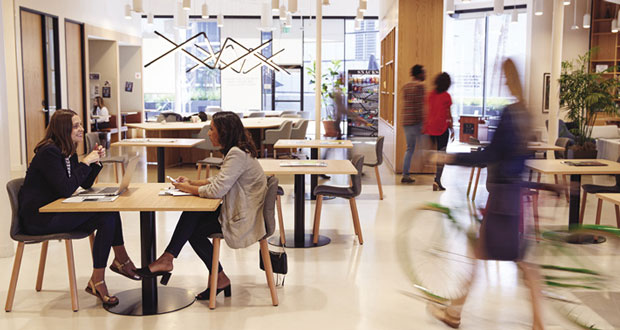
As coworking occupancy rises sharply alongside the return-to-office push, with flexible office space now accounting for around 20 per cent of all leasing activity in major UK cities, a growing share of workplace demand is being absorbed into landlord-controlled, multi-tenant environments where individual company responsibility for energy use is effectively relinquished. What appears as a flexible solution to hybrid working is, in practice, creating a layer of concentrated, poorly monitored energy consumption across city centres. With Earth Day sharpening focus on delivery over ambition, this shift is emerging as a material risk to net zero progress, according to SaveMoneyCutCarbon, the UK’s largest integrated decarbonisation delivery platform.
Office occupancy across major cities has stabilised at around 50 to 60 per cent of pre-pandemic levels, while demand for coworking and flexible office space continues to expand rapidly. As more businesses re-enter physical workspaces via shared environments, SaveMoneyCutCarbon says responsibility for energy consumption becomes fragmented between landlords and transient occupiers, limiting both visibility and control at the point of use.
The structural limitations of coworking are becoming clearer against the requirements of net zero delivery. Unlike single-tenant offices, where energy performance can be tracked and tied directly to business outcomes, shared workspaces operate across multiple users with limited accountability. Heating, lighting and equipment are often used continuously regardless of actual need, weakening efficiency gains. This challenge sits within a wider system where buildings account for around 25 per cent of the UK’s total greenhouse gas emissions, placing commercial real estate at the centre of any credible decarbonisation strategy.
As coworking scales across dense urban centres, the inability to monitor and manage energy consumption at a granular level risks undermining progress at precisely the point it needs to accelerate. At the same time, hybrid working is redistributing rather than reducing energy use across homes, offices and shared spaces. In coworking environments, concentrated peak demand during core hours intensifies this effect, increasing pressure on building systems while limiting businesses’ ability to benefit from efficiency measures such as on-site generation or smart energy systems.
According to SaveMoneyCutCarbon without clearer accountability, improved measurement and stronger incentives for operators to prioritise efficiency, the continued expansion of coworking risks creating a structural gap between net zero ambition and delivery, particularly in cities where commercial buildings play an outsized role in emissions.
Mark Sait, CEO of SaveMoneyCutCarbon, said: “Energy is now one of the largest operating costs for businesses, but in shared workspaces companies have very little control over how that energy is used. That disconnect is becoming a real barrier to both cost management and carbon reduction.”