 FMJ Facilities Management magazine providing industry-specific intelligence to FM and property professionals

 Marking a year since Simpler Recycling came into effect, Martyn Hodgkinson, Senior Manager, Brand Commercialisation EMEA at Rubbermaid Commercial Products (RCP) explains how to review progress to unlock capability
Simpler Recycling, which came into effect last year, is designed to standardise waste collection and management across England, requiring all businesses with 10 or more full-time employees to separate their waste streams on site, prior to collection from a waste contractor.
After taking action to comply with the new regulations, Simpler Recycling has evolved from a pressing concern to an operational reality, but that’s not the end of the story.
You’ve invested in the bins, delivered training to your staff and updated your policies. The box has been ticked, and your facility is compliant. But while meeting the requirements laid out by Simpler Recycling is one thing, building a system that works, intelligently solving your waste management issues, is another entirely.
The system you built to comply with the changing regulations could inadvertently be the cause of hidden costs, lost productivity and growing inefficiency.
It can be hard to spot, but this gap can impact your facility in several ways:
Contamination – Low recycling rates and cross-contamination are a surefire sign that something is wrong with your system. One piece of plastic wrap in the cardboard stream, food in your mixed recycling and your carefully separated waste ends up contaminated and can lead to increased costs from your waste management contractor.
Lost productivity – A key concern is the impact of waste management systems on productivity. The way that your system was designed, right down to the placement of your bins, can have a massive impact, as centrally or poorly located bins can force staff to make multiple trips to properly dispose of waste. Even if those trips only take a few minutes, those small inefficiencies can quickly add up, especially if they are replicated across an entire facility.
Inefficiency – Poorly designed systems create additional work as people are forced to spend time fixing errors, managing overflowing bins, and checking waste that should have been separated at the point of collection.
GOING BEYOND COMPLIANCE
Compliance shouldn’t be viewed as a finish line but as a foundation on which you can build and refine your waste management systems. No matter how much thought, planning and preparation went into its creation, the waste management you put in place to meet the requirements of Simpler Recycling may be already outdated. If you want to elevate your waste management system, here are some simple steps you can take:
Find out where things are failing – Your first step should be to understand what’s working and where things are breaking down. A ‘waste walk’ is a systematic tour of your facility to assess your current set-up, where waste’s being generated and how much, and where contamination may happen. This takes out the guesswork, helping you to make informed decisions about improvements. Do this once a quarter and you’ll pick up on good and bad recycling trends and behaviours.
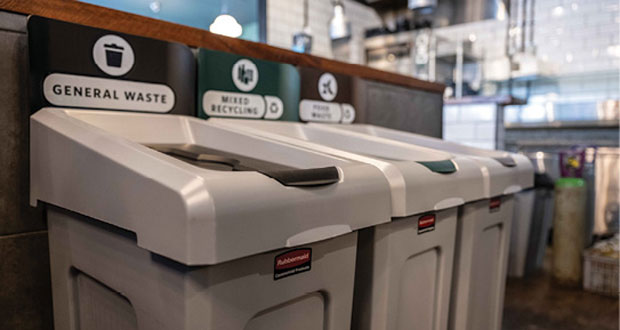
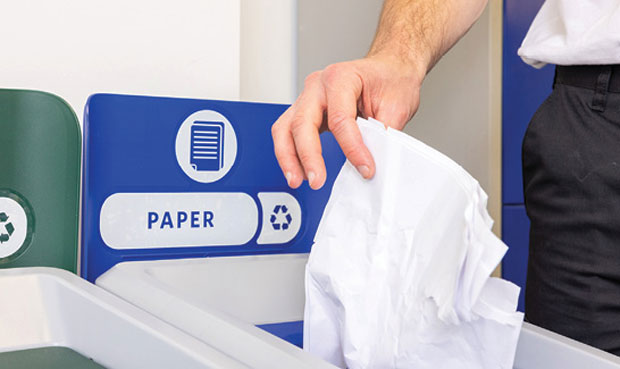
Clear labelling – Iconography, colour-coding and custom signage are key to effective labelling, a vital tool to help people separate waste correctly at the point of collection and significantly reduce disruption and contamination, so consult employees to find out if your labels are effective.
The right bins for the job – Compact solutions with narrow footprints and modular designs mean recycling can work within your space, not against it. Choosing the right bin for the environment will ensure that your people can effectively separate waste at the point of collection, wherever they are in your facility.
Industrial-grade solutions – Cheap solutions such as budget bins may not be tough enough to stand up to the rigours of day-to-day work. This could lead to FOD (Foreign Object Debris) hazards and contamination crises. No one wants to have to replace items after only a year in use. But replacing substandard bins with industrial-grade solutions now, will be well worth it in the long run.
Re-engage your people – To be effective, education needs to be continuous. Is the training you delivered when Simpler Recycling was first rolled out already been forgotten? Without ongoing support, fatigue sets in and even the best systems can fail. Re-engage your people, help them to understand the real, visible benefits of recycling so that it moves beyond a tick-box exercise to become a shared cultural commitment.
THE TIME TO ACT IS NOW
A year on from its implementation, the direction of travel that started with Simpler Recycling is clear. With more legislative changes slated for 2026 and beyond, waste management is going to be an ongoing concern for some time to come.
Compliance is important, but it’s only a starting point. Facilities that treat recycling as an opportunity rather than an obligation can unlock genuine benefits from lower costs to increased productivity. But the time to act is now, and facilities that take steps to review and refine their recycling will be the ones best positioned to adapt to the changing legislative landscape.
For more information visit www.rubbermaid.eu/en/