 FMJ Facilities Management magazine providing industry-specific intelligence to FM and property professionals

 Ahead of summer shutdowns, Dean Skerratt, Business Development Director for Climate Centre, considers some of the key checks and maintenance tasks that FMs and building managers should schedule to maintain reliability and efficiency of air conditioning and climate control systems
Across many commercial buildings, from schools and colleges to manufacturing facilities and offices, the summer period presents an ideal opportunity to undertake planned maintenance work. Occupancy levels are lower, which minimises any disruption to operations, and in some cases the entire premises will close. Maintenance and engineering teams have valuable access to plant and equipment that might otherwise be difficult to reach during normal business activities.
Whilst this provides an opportunity to focus on major refurbishment projects or statutory compliance checks, building managers and FMs should also take the chance to check air conditioning and climate control systems, particularly as they work hardest during the warmer months. A well-planned inspection and servicing programme can help improve system performance, reduce energy consumption and minimise the risk of costly breakdowns when buildings return to full operation.
Why maintenance matters
Any air conditioning system that has been operating continuously for months can experience reduced efficiency due to dirt accumulation, wear and tear, and unnoticed component issues. Summer shutdowns provide an ideal window to identify and address these problems before they develop into more serious faults.
Notably, preventative maintenance not only helps extend equipment lifespan but can also support sustainability targets by ensuring systems operate as efficiently as possible.
Start with a comprehensive inspection
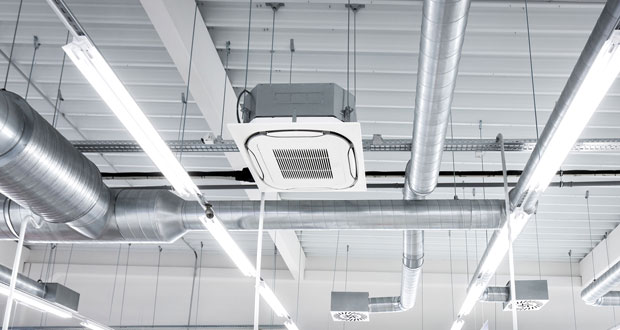
The first step should be a thorough inspection of the entire system from a competent engineer. This includes both indoor and outdoor units, associated controls, ductwork and pipework.
An inspection will cover any signs of physical damage, corrosion, refrigerant leaks and loose electrical connections. Outdoor condensers are particularly vulnerable to debris build-up, weather-related damage and restricted airflow, all of which can negatively affect performance.
Check refrigerant levels
Maintaining correct refrigerant charge is essential for efficient cooling performance. Low refrigerant levels can indicate leaks and may result in increased energy consumption, reduced cooling capacity and potential compressor damage.
During planned shutdowns, qualified engineers should check refrigerant levels, inspect pipework and fittings, and verify that systems are operating within manufacturer specifications.
With evolving environmental legislation and increasing focus on refrigerant management, regular inspections will also help make sure organisations remain compliant with low-GWP refrigerant requirements, and can reduce environmental impact in doing so.
Tasks for site teams
There are also a number of simple but effective maintenance tasks that site teams can perform, irrespective of internal competency or qualifications.
One of the simplest but most effective tasks is cleaning or replacing air filters. Dirty filters restrict airflow, forcing systems to work harder and consume more energy. They can also negatively impact indoor air quality by allowing dust and contaminants to circulate throughout occupied spaces.
Evaporator and condenser coils should also be inspected and cleaned where necessary. Over time, dirt and grime can accumulate on coil surfaces, reducing heat transfer efficiency and increasing operating costs.
In industrial environments such as factories and workshops, where airborne particles may be more prevalent, coil cleaning can deliver particularly significant performance improvements.
Documenting the condition of each system can also help support a long-term maintenance strategy and identify assets that may be approaching replacement age.
Inspect ductwork and airflow
Air distribution is just as important as cooling capacity. Damaged, leaking or obstructed ductwork can reduce system efficiency and create uneven temperatures throughout a building.
With this in mind, shutdown periods also provide an opportunity for maintenance engineers to inspect accessible ductwork for signs of damage, loose connections or deterioration of insulation. Air grilles and diffusers should also be checked and cleaned to ensure unrestricted airflow.
In addition, if condensate drainage systems become obstructed, water can back up into units, causing leaks, water damage and potential system shutdowns. Routine inspection and cleaning of drain pans and condensate lines can help prevent these issues and help maintain reliable operation.
Assess controls and system settings
As well as physical maintenance of the system, summer shutdowns provide an opportunity to review control strategies too – making sure systems align with up to-date occupancy patterns and operational requirements. Building usage often changes over time, but system settings may remain unchanged for years.
This would include timers, thermostats, sensors and building management system integrations – where incorrect settings can lead to unnecessary energy consumption, inconsistent temperatures and dissatisfied occupants.
In schools, for example, teaching spaces may have been repurposed or extended, while factories may have altered production schedules. Without reviewing controls, air conditioning systems may not respond effectively to actual building usage.
Plan ahead for future maintenance
Summer shutdowns should not be viewed as a one-off maintenance exercise. Instead, they offer an opportunity to review overall asset performance and establish a proactive maintenance schedule for the year ahead.
This approach not only reduces the likelihood of unexpected breakdowns, but also supports lower operating costs, improves occupant comfort and maintains asset longevity.
With energy efficiency and resilience becoming increasingly important priorities across the built environment, making air conditioning maintenance a key part of summer shutdown planning can deliver benefits well beyond the summer.