 FMJ Facilities Management magazine providing industry-specific intelligence to FM and property professionals

 Mark Humphreys, CEO of property and construction consultancy Airey Miller, shares his views on why stadiums are becoming FM-driven smart assets
Football stadiums are no longer single-use venues. They are complex, operational estates running seven days a week and they increasingly demand the same level of facilities management as any commercial asset.
From conferences and corporate hospitality to community programmes and large-scale events, clubs are managing multi-use environments where safety, compliance and efficiency are critical. Yet across the UK, many stadiums rely on legacy drawings, fragmented digital files or knowledge held by long-standing staff. For facilities managers, that presents a growing risk but also an opportunity.
Airey Miller’s recent partnership with Bromley FC reflects a shift that is beginning to reshape how these assets are understood and managed; the adoption of digital twins.
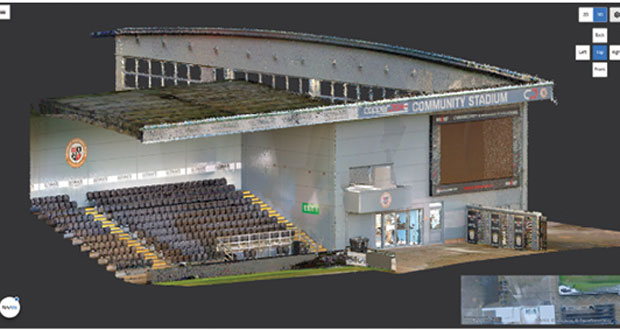
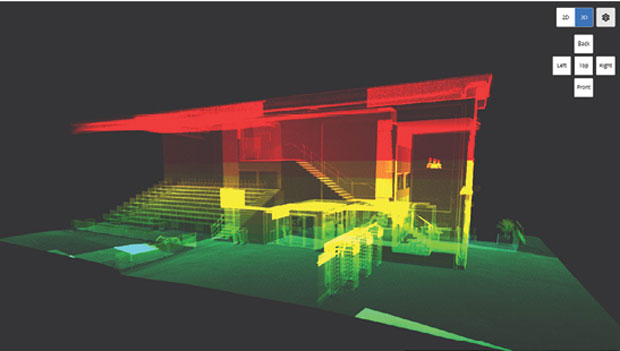
Using advanced mobile mapping technology, the club’s stadium is being captured as a high-accuracy, immersive 3D digital model that captures every accessible internal and external space. But this is more than a visual replica. It is a data-rich environment that supports asset management, compliance and operational decision-making in real time.
ACCURATE DATA
One of the biggest challenges in facilities management is access to accurate, up-to-date building information. In many stadiums, critical data sits across multiple systems, or worse, in paper files. When issues arise, time is lost locating drawings, verifying dimensions or conducting repeat site visits.
A digital twin addresses this by consolidating asset information into a single, accessible platform. Facilities teams can remotely navigate the building, interrogate plant rooms, check access routes and confirm spatial constraints without leaving their desk.
This becomes particularly valuable when coordinating contractors or responding to faults. Instead of relying on assumption or outdated plans, FM teams can provide precise, visual context, improving response times and reducing the risk of error, it removes reliance on institutional memory. When staff move on, knowledge doesn’t leave with them, it remains embedded within the asset itself.
ENABLING THE ‘GOLDEN THREAD’
The regulatory landscape is also shifting. In the wake of the Building Safety Act, the principle of maintaining a clear and accessible ‘golden thread’ of information is becoming embedded across the built environment.
Digital twins provide a practical route by creating a living record of the building, capable of being updated over time and shared securely with stakeholders. This supports audit readiness, strengthens compliance processes and reduces exposure to risk.
Historically, detailed surveying has been seen as intrusive particularly in live environments, like stadiums. Closing areas, erecting tripods or restricting access can have direct commercial implications. New-generation mobile mapping changes that dynamic. Wearable scanning systems allow surveyors to move freely through a building, capturing large volumes of data quickly and accurately in a single pass. Entire stadiums can be mapped in hours rather than days, often without the need to interrupt normal operations.
Applications include supporting planned and reactive maintenance by providing accurate spatial context; enhancing fire safety planning through clear visibility of routes, systems and access points; streamlining contractor engagement with better upfront information; improving space planning for events and commercial use and reducing unnecessary site visits through remote access.
PLANNING FOR CHANGE AND GROWTH
Stadiums are not static assets. Many clubs; particularly outside the top tier; are actively exploring expansion, refurbishment and reconfiguration to meet league requirements and commercial demand.
For facilities managers, this creates additional pressure as poor quality data can lead to design clashes, delays and cost overruns. A digital twin provides a reliable baseline for future works. Accurate spatial data supports design development, improves coordination across project teams and accelerates the route to planning and delivery.
In the case of Bromley FC, current on-pitch success brings the possibility of promotion and stadium upgrades. Having a construction-ready digital model in play allows the club to move at pace and with greater confidence if those requirements materialise.
The evolution of stadiums mirrors a broader trend across the built environment: the emergence of digital twins as the backbone of compliant asset management. Expectations on FM are rising with teams being asked to do more with less, while maintaining higher standards of safety, performance and user experience. Digital twins sit at the intersection of these pressures. They enable a shift from reactive to proactive management, offering the tools to anticipate issues, optimise operations and demonstrate control over assets.
While adoption has been strongest among larger organisations, the opportunity is arguably greater further down the leagues, where improved asset intelligence can unlock efficiencies and support investment cases.
The partnership between Airey Miller and Bromley FC is indicative of a wider change in mindset. Digitisation is no longer confined to front-end experiences or smart building systems; it is becoming fundamental to how assets are managed.
Accurate, accessible building data is moving from “nice to have” to operational necessity. As stadiums continue to evolve into multi-use destinations, digital twins are set to become part of the standard FM toolkit; underpinning safer, more compliant and more commercially effective operations.