 FMJ Facilities Management magazine providing industry-specific intelligence to FM and property professionals

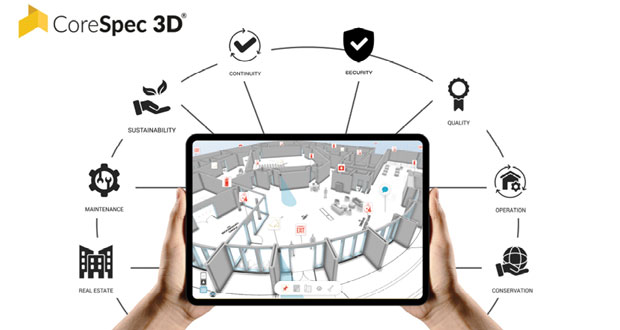
 Timber Barker, CEO of Boom Interactive and Creator of CoreSpec 3D, sets out how AI and digital technologies helps consolidate all facilities information into an Integrated Facilities Management Services (IFMS) strategy
According to a recent report by askporter, facilities management teams are in a state of perpetual crisis management, with a staggering 73 per cent of teams resorting to reactive problem-solving due to a lack of real-time insights. Not only is this reactive style of work eroding client trust and confidence, but it is also causing 43 per cent of FMs to miss their Service Level Agreements (SLAs) – resulting in many clients going on to raise complaints or threatening not to renew contracts over perceived service failures.
THE ISSUE
One of the main issues preventing FM teams from shifting away from reactive schedules is the skills shortage. The askporter data highlighted that over two-thirds (68 per cent) of FM leaders are struggling to find and retain skilled staff. Couple this with a loss of institutional knowledge from a retiring workforce and the pressure is well and truly on those who remain.
In addition to this, teams are under increasing financial pressure. The most recent ‘State of FM’ report by SFG20 found that budget constraints are the biggest challenge faced by those in the industry – with 69 per cent citing this as their biggest obstacle in 2026. Add to this the fact that some research has shown that around 30 per cent of as-builts drawings contain errors or missing information and that no single FM contract in the UK has a 100 per cent accurate, fully updated asset register at the point of contract handover and it’s clear the issue is much than just financial – it’s information too. It is these factors that are playing into an inability to look at buildings more predictively.
All of this, plus aging infrastructure, complex compliance and regulation changes and technology integration are combining to create a tough landscape for FMs. It is these factors that are playing into an inability to look at buildings more predictively, with teams kept busy fighting fires on a daily or weekly basis rather than planning ahead.
DIGITAL WAY FORWARDS
Within the FM sector there seems to be a general acceptance that digital technologies and AI platforms are the future, with data and systems integration one of the top challenges for UK practitioners in 2026.
Many teams are already using digital technologies, with buy-in to tech adoption seen as ‘strong’ amongst many FM leaders. Despite this, these technologies do come with some drawbacks, namely the use of multiple siloed systems, causing fragmentation across a wider business or even throughout a diverse property portfolio.
Additionally, there are concerns amongst the workforce that despite the benefits digital technologies can bring they can often be stuck behind a ‘skills paywall’ where specific training or knowledge is needed to operate a system.
According to the 2026 ‘State of FM’ report, many in the industry see the integration of technology as one of the biggest challenges this year, with worries ranging from integration into current processes, to the ways in which they can support compliance and reduce operational costs being raised. It is here that intuitive AI-based tools can prove useful, offering an easy-to-use system with the same capabilities as more advanced solutions.
AI IN FM
AI in the FM sector is by no means a new concept, with the rapid adoption of AI as a mainstream tool beginning around 2023 in the UK. However, since this time it has grown exponentially into an even more powerful system, especially when incorporated into a wider solution to provide a generative learning model. In fact, it is this introduction of AI to workflows that can massively benefit a shift to predictive maintenance.
CoreSpec 3D is an app-based software with an AI assisted image recognition to rapidly create interactive, living floor plans from 2D drawings and share them seamlessly across all device types, streamlining design and planning while reducing costly on-site adjustments. Designed to be used by everyone, not just specialists, this platform can fit into existing workflows and track a building from initial design right through to detailing, completion and maintenance – offering a solution to the ‘as-built crisis’ by aggregating existing systems, documents, drawings and live operations into one interactive, layered and shareable scene.
FUTURE OF AI
As an AI system gathers and collates data, it can learn and better adapt, shifting any tool it is incorporated into from a dashboard of information into a truly smart model. In the context of facilities management this can help regulate a building itself. Whether that is measuring energy usage and finding better ways to control internal environments more efficiently or allocating jobs that will need completing before they become an actual problem – saving time, resources and money.
Take a building’s lighting for example, an AI-based system can not only control the lighting, reducing energy usage, but by taking data from across the property and wider portfolio it can then look to recommend when different fixtures would require replacing or maintenance – as opposed to waiting for an issue to arise before acting.
AI and digital technologies can be used to help teams shift from this reactive way of working to more predictive maintenance cycles.