 FMJ Facilities Management magazine providing industry-specific intelligence to FM and property professionals


 The data-driven performance monitoring of heat networks is becoming mandatory. Adam Newman, Head of Technical Solutions at Insite Energy outlines how to prepare for the new regulations
As the UK heat network sector moves towards formal regulation, facilities managers face a fundamental shift in how they monitor communal and district heating systems. What was once a largely billing-focused task is becoming a data-driven discipline centred on performance, efficiency and accountability.
Central to this transition is the concept of a ‘golden thread’ of data. Defined by the Department for Energy Security and Net Zero (DESNZ) as “the information that allows you to understand a heat network and maximise its performance, now and in the future”, in practice, it means a continuous, reliable flow of data running through every part of the system, from the energy centre to the end-user.
PERFORMANCE INTELLIGENCE
Historically, heat network data requirements have been relatively modest. Monthly meter readings for billing purposes were sufficient to comply with the Heat Network (Metering and Billing) Regulations.
But that is set to change in 2027 with the introduction of the Heat Network Technical Assurance Scheme (HNTAS). Operating alongside existing regulations, this code of technical standards demands a step change – from periodic collection of consumption data to continuous performance monitoring. It’s no longer enough to know how much energy is used; FMs must now also understand in near real-time how efficiently it’s being generated, distributed and consumed.
Under the proposed framework, networks will be required to report against key performance indicators (KPIs). And, while the responsibility for adherence to specific standards sits with the heat supplier, in practice, FMs will play a central role in delivering and evidencing compliance on the ground.
While there is still uncertainty around how and where data will be submitted, the fundamentals of effective monitoring are already clear. The overarching aim is to transform a heat network from a ‘black box’ into a transparent, optimisable system.
IDENTIFYING CRITICAL DATA POINTS
Performance will be assessed across six core elements:
- The energy centre: the main plant room where heat is generated.
- The district distribution network: the pipework connecting multiple buildings or zones.
- The substations: the heat exchanger connection between district and communal networks.
- The communal distribution network: the pipework distributing heat within a building.
- The consumer connection: the heat interface unit (HIU) where heat enters the home.
- The consumer heat system: the internal heating system within the customer’s premises, such as radiators, hot water cylinders, and underfloor heating.
Each of these elements carries specific metering and monitoring requirements with data collection at five or 30-minute intervals. At energy centre level, gas and electricity consumption must be tracked alongside other important variables like heat output, operational uptime, water consumption and network pressure so leaks or other issues can be detected.
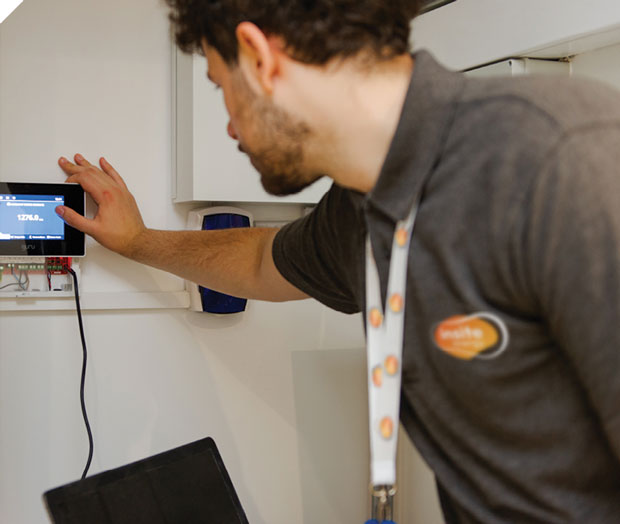 Across the network, flow and return temperatures are crucial as they underpin a critical performance indicator: Delta T (the difference between them). A low Delta T often signals inefficiencies such as poor heat transfer or system imbalance, which can increase pumping energy, reduce capacity and ultimately increase operating costs.
At building and apartment level, data can reveal important issues like excessive heat losses, poor control settings or underperforming emitters. This granular insight enables targeted interventions, such as adjusting system parameters, resolving faults or improving insulation, avoiding reliance on reactive maintenance once problems snowball.
VOLUME, STORAGE AND ACCESS
Collecting information is only part of the equation, however. The real challenge is managing it. Over a year, a single monitoring point could produce over 100,000 data entries. Multiply that across dozens of meters and multiple sites, and the scale becomes clear.
Platforms must now be capable of processing very large datasets while ensuring long-term accessibility and integrity. Information should also be presented meaningfully, through dashboards, alerts and reporting tools allowing FMs to act on it quickly.
This is where the golden thread concept becomes practical. Data must not only be collected, but connected, flowing seamlessly from on-site meters through to central platforms and regulatory reporting frameworks. Open-protocol systems are increasingly being adopted to allow integration across multiple networks and assets, providing a single source of truth.
ACT NOW
With the HNTAS consultation recently closed and roll-out expected to begin next year, there’s a window of opportunity to prepare. The best starting point is a gap analysis to understand what data is currently collected and what’s missing. For many older sites, significant upgrades may be required.
From there, FMs should focus on three key areas:
- Monitoring points – ensure all meters and sensors are in place so data can be captured across the six network elements. This includes heat meters, licenced utility meters, other sub meters, and pressure, temperature & other sensors.
- Data communication systems (DMS) – identify how and who will communicate data via automatic meter readings (AMR), utility company APIs, or the Building Management System (BMS).
- Data analysis system (DAS) – identify where and how data will be stored and managed, and how KPIs will be calculated. This may include platforms such as cThings, RavenResidential, or Guru Pinpoint.
- Data consumers – ensure data is sent to HNTAS’ digital platform for KPI submission, and other applications to further monitor, report on, and respond to data. This includes setting thresholds for alerts, defining maintenance triggers and ensuring performance issues are addressed promptly.
GOLDEN OPPORTUNITY
The move to HNTAS is about raising standards across the heat network sector, yet the transition is not without its challenges. Data volumes are increasing, systems need upgrading, and responsibilities are expanding. But the benefits of the golden thread of data are clear: more efficient networks, lower operating costs and improved outcomes for residents.
Preparedness varies widely across the property sector. Larger housing associations and portfolio owners are generally more advanced, already exploring data platforms and standardisation strategies. Meanwhile, smaller managing agents and resident-led organisations may have limited awareness or capability.
For FMs, this creates both a challenge and an opportunity. There is a growing need for expertise in navigating regulations, implementing data systems and interpreting performance metrics. Those able to provide this will be well positioned as the market evolves.