 FMJ Facilities Management magazine providing industry-specific intelligence to FM and property professionals

 Smoke, road closures and fast-changing local conditions can affect buildings, outdoor areas and mobile workers long before flames reach an organisation’s estate. Josh McNicholas, a senior lead at Evalu-8, explains the practical checks facilities teams should be completing.
Wildfire is easy to categorise as an emergency-services, environmental or rural land-management issue.
For facilities and estates teams, however, the operational effects can begin well before flames reach the boundary of a property.
Smoke may enter occupied buildings. An access road used by maintenance contractors may close. A mobile engineer may lose their planned route away from a remote site. Grounds maintenance, hot work or the use of petrol-powered equipment may become more hazardous because surrounding vegetation is unusually dry.
A task assessed as routine when it was scheduled can quickly become a different job.
On 14 July, Reuters reported that at least 19 wildfires had been reported across England and Wales, with major incidents declared in affected areas and smoke travelling beyond the immediate fire zones. On the same day, the UK Health Security Agency warned that hot, dry weather removes moisture from vegetation and provides more fuel for fires. It added that climate projections suggest the UK will experience conditions increasingly favourable to larger and more severe wildfires.
Facilities teams do not need to predict where a fire will travel. That remains the responsibility of the emergency services and relevant public authorities.
They do need a reliable process for recognising when local conditions have changed, understanding which parts of the estate or workforce may be affected and deciding whether planned work should continue, change or stop.
The following five checks provide a practical starting point.
- Identify which parts of the estate could be affected
The first mistake is to look only at properties located immediately beside a known fire.
Wildfire disruption can extend much further through smoke, road closures, restricted access, changes to public transport and demands on emergency services. A site can therefore be operationally affected without being inside an evacuation area.
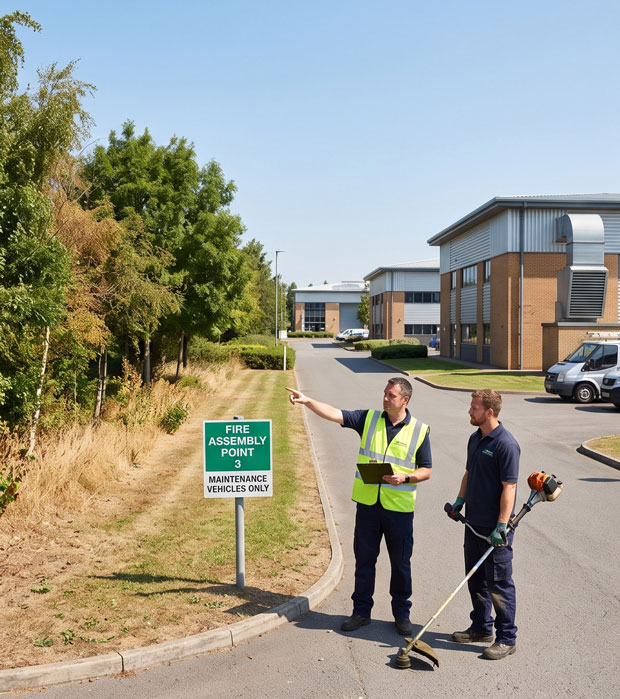 Facilities and estates teams should identify properties, routes and activities that may have greater exposure, including:
- Buildings next to grassland, woodland, peat, moorland or unmanaged vegetation
- Schools, care facilities and public buildings with extensive grounds
- Remote plant, substations, compounds and utility infrastructure
- Rural roads, service routes and access tracks
- Construction, maintenance and highways projects
- Sites with only one practical vehicle entrance or exit
- Locations regularly visited by lone workers or contractors
- Logistics routes passing through affected areas
The aim is not to create an unofficial fire map. Managers should use current information from fire and rescue services, the police, local authorities and transport providers.
They can then consider a more immediate operational question: if the usual route became unavailable, could workers, occupants or contractors still enter and leave safely?
That review should cover more than the main entrance. Fire-service access, delivery gates, contractor parking, pedestrian routes, assembly points and alternative exits may all be affected differently.
Where necessary, temporary arrangements could include changing the route, moving the work, increasing supervision, restricting parts of the site or postponing a non-essential visit.
- Review how smoke could affect buildings and occupants
A facility does not need to be close to visible flames to experience the effects of a wildfire.
UKHSA warns that wildfire smoke can contain fine particles, carbon monoxide, nitrogen oxides and other pollutants. Exposure may result in irritation, coughing, wheezing or breathlessness, with children, older people, pregnant women and people with existing heart or respiratory conditions facing greater risks.
For facilities teams, this introduces both an occupational-health issue and a building-management issue.
Managers should establish:
- Whether smoke is visible or can be detected at the site
- Whether occupants are reporting symptoms or concerns
- Whether vulnerable employees, residents, patients or pupils are present
- How external air enters the building
- Whether windows, doors or loading bays are being left open
- Whether ventilation or air-conditioning systems draw air from outside
- Who is monitoring conditions and how frequently
- Which official advice will be used to trigger further action
UKHSA advises people in smoke-affected areas to remain indoors where it is safe to do so, close windows and doors and switch off air-conditioning systems that draw air from outside.
Applying that advice across a working building may require more judgement than simply switching equipment off. Facilities teams may also be managing indoor temperatures, specialist ventilation, critical rooms, vulnerable occupants and life-safety systems.
Any temporary adjustment should therefore be building-specific and made by someone who understands the systems involved. It must not compromise fire detection, smoke control or other safety-critical equipment.
Multi-site organisations should also avoid issuing one vague message and leaving individual managers to interpret it without support. Local decisions may differ, but the process, escalation route and information used to make them should remain consistent.
- Reconfirm access, communication and escalation arrangements
Wildfire disruption creates particular difficulties for people who work away from a permanently staffed location.
This can include mobile engineers, security teams, grounds staff, caretakers, surveyors, maintenance workers, drivers and contractors visiting remote parts of an estate.
Before somebody travels to a potentially affected area, managers should reconfirm:
- Where the person is expected to be
- Which route they intend to use
- Whether that route remains open
- What time they are expected to arrive and leave
- How and when they will check in
- Whether mobile or radio coverage is reliable
- What they should do if access is blocked
- Who will respond to a missed check-in
- How the organisation will confirm they have left safely
HSE guidance requires employers to manage the risks faced by lone workers, including appropriate training, supervision, monitoring and arrangements for maintaining contact and responding to an incident. It also advises employers to test communication systems and have a reliable way of confirming that a lone worker has returned after completing a task.
A telephone number stored in a procedure is not, on its own, an effective control. The arrangement has to work in the location and conditions the worker is likely to encounter.
Workers should also know they can turn back or stop the task if conditions differ materially from the plan. A lone worker who discovers smoke, a closed road or an unavailable escape route should not feel pressured to continue simply because the visit has already been authorised.
The same information must reach contractors, agency workers and service partners.
A temporary instruction is ineffective if it remains inside the client’s management team while a contractor arrives with yesterday’s permit, route information or method statement.
- Reassess work that could introduce an ignition source
Facilities teams should pay particular attention to planned activities involving heat, sparks, flames or hot equipment near dry vegetation.
Depending on the estate, this may include:
- Welding, cutting and grinding
- Roofing and other hot works
- Petrol-powered grounds equipment
- Mowing or strimming in very dry areas
- Temporary generators
- Plant with exposed hot exhaust systems
- Outdoor catering equipment
- Smoking arrangements
- Burning waste or vegetation
- Damaged electrical equipment capable of producing a spark
This does not mean every activity involving heat or powered equipment must automatically stop.
It means the risk should be reassessed against the conditions present on the day, the surrounding environment and current emergency-service advice.
HSE guidance advises organisations to identify sources of fuel and ignition, maintain suitable means of escape and review risk controls when workplace changes could introduce new hazards or make existing controls less effective.
Where a permit-to-work system is used, the person approving the activity should have access to current information rather than relying solely on the conditions recorded when the work was originally planned.
The review might result in additional fire-watch arrangements, a different work location, vegetation controls, changes to the timing of the task or postponement until conditions improve.
Facilities teams should also consider whether an interruption would leave equipment, materials or part-completed work in an unsafe state. The decision is not simply whether the activity can start, but whether it can be suspended and the area made safe if conditions deteriorate.
- Record temporary controls and give them a review point
Fast-moving situations are often managed through phone calls, group messages and email chains.
That may help people respond quickly, but it can leave the organisation without a clear record of:
- Which locations were reviewed
- What official information was available
- Who made the decision
- Whether work continued, changed or stopped
- Which workers and contractors were informed
- What temporary controls were introduced
- Which actions remain outstanding
- When the decision will be reviewed
HSE’s risk-assessment guidance recommends recording significant findings, identifying further action, assigning responsibility and setting a timescale for completion.
A wildfire-related record does not need to become a lengthy report. It should make the current position understandable to another manager, the next shift or somebody covering an absence.
Whether the organisation uses an EHS system, a CAFM platform or a temporary incident log, affected teams should be working from one current version of the decision.
Every temporary control should also have an owner and a defined review point.
That review may be triggered by:
- Updated fire-service or police advice
- A road opening or closing
- Smoke reaching the site
- A change in wind direction or visibility
- A worker reporting deteriorating conditions
- A missed lone-worker check-in
- A change to the planned task
- A contractor arriving on site
- The beginning of a new shift
Without a review trigger, temporary measures can remain in place after they are needed, or disappear before the risk has passed.
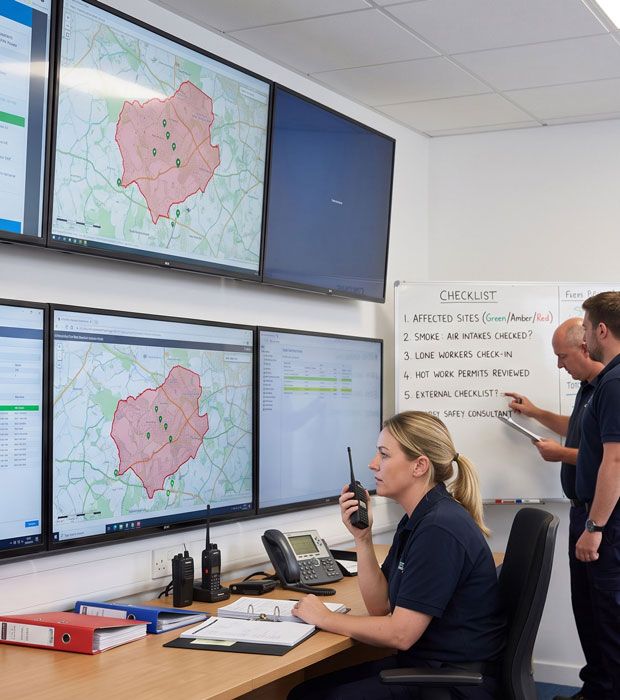 Turn the warning into a clear operational briefing
Forwarding a wildfire alert is not the same as managing its effect on an estate.
Affected workers, contractors and site managers need to understand what the alert changes for them.
A temporary briefing should explain:
- Which sites, outdoor areas or routes may be affected
- Which activities have changed or been suspended
- What conditions should trigger a stop-work decision
- Who is monitoring official information
- How mobile or lone workers must check in
- Who should be contacted if access becomes restricted
- What to do if the normal exit or route is unavailable
- When the arrangements will next be reviewed
Facilities teams should also consider how receipt of the briefing will be confirmed. Posting an update on an intranet or sending an email does not guarantee that a mobile engineer, agency worker or external contractor has seen and understood it.
The organisation should be able to establish who has received the revised instructions, particularly where they affect access, evacuation or permission to undertake higher-risk work.
Employers do not need to predict the fire
The aim is not to turn facilities managers into wildfire specialists.
It is to apply familiar risk-management disciplines to a fast-changing external event.
Facilities and estates teams are already accustomed to translating weather warnings, utility failures, security incidents and transport disruption into practical decisions. Wildfire should be approached in the same way.
Understand which parts of the estate could be affected. Check whether buildings, access routes and planned work remain safe. Brief employees and contractors. Record the decision. Assign further action and review it as official advice changes.
A task assessed as routine last week may no longer be routine when smoke, access, communication or evacuation arrangements have changed.
The wildfire plan is not complete when the alert has been forwarded.
It is complete when the organisation knows who may be affected, what they have been told, what has changed and who is responsible for making the next decision.
About the author
Josh McNicholas is a senior lead at Evalu-8, a UK provider of environmental, health and safety management software. He works with organisations reviewing how they manage risk assessments, site inspections, contractor activities and corrective actions across complex and dispersed operations.