 FMJ Facilities Management magazine providing industry-specific intelligence to FM and property professionals

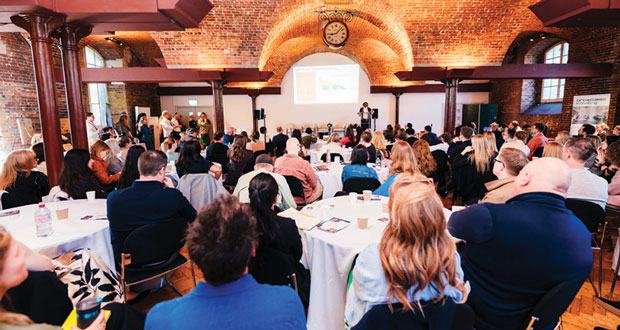
The Sustainable Design Forum examined how collaboration, authentic design and circular thinking are shaping greener, healthier spaces for the future. Madeleine Ford reports
Marking its fourth year, the Sustainable Design Forum took place 23 April at Crypt on the Green in Clerkenwell. The event is curated by the Sustainable Design Collective (SDC), a voluntary think tank of architects, designers and specifiers whose mission is to connect, inspire and engage. The Collective believes that sustainability is about balancing three key factors- products, places and people, an approach which has evidently filtrated down into the ethos and content of this event. This year’s forum brought together industry leaders, designers and architects for a day of insight, collaboration and discussion to explore how sustainable thinking can move beyond theory and into practical, measurable action.
OPENING REMARKS
The tone of the day was set in the opening address by Dr Valerie Vaughan-Dick MBE, Chief Executive Officer of the Royal Institute of British Architects (RIBA) who explored the opportunities and challenges in advancing sustainability across the built environment. Her involvement in the event highlighted the important role of industry leadership in supporting environmental responsibility, social value, and inclusivity.
Dr Vaughan-Dick’s address centred on the idea that sustainability must be embedded into every stage of design and decision-making, rather than treated as an afterthought or compliance exercise. She emphasised that architects, designers and FM professionals all play a critical role in shaping the lifecycle of buildings, from concept and construction through to operation and end-of-life reuse.
She spoke about the need for genuine collaboration across disciplines, stressing that sustainable outcomes are only possible when stakeholders work together with shared goals. Vaughan-Dick further highlighted the importance of education and leadership in driving meaningful progress and encouraging organisations to invest in both knowledge and accountability.
Her message was clear: sustainability is not simply about reducing harm, but about creating buildings and spaces that actively contribute to environmental and social wellbeing.
WHERE SUSTAINABILITY STARTS
One of the standout sessions of the day, entitled ‘Greener Thriving Spaces for People + Planet’, hosted by Sam Allen, Associate Director for Engineering Technology & Sustainability at M Moser Associates, discussed the challenges in designing for people and public spaces and the need for authenticity in sustainable design.
The panellists: Asif Din, Director of Regenerative Design at Perkins & Will, Lucy Bagshaw, Director of Sustainability at TP Bennett, Katie Bowes, Head of Design at Axis @ Work, and Phil Towle, Head of Sustainability & Supply Chain at Future Works, were posed the opening question, what is the biggest challenge in terms of designing for people and public spaces?
Phil Towle stated that from his experience gaining stakeholder alignment across both clients and supply chains was the biggest challenge. He spoke candidly about the challenges of bringing these parties together – along with contractors and designers – in a shared sustainability vision as differing priorities, from cost constraints to programme pressures, can dilute sustainability goals before they are fully realised. The panel stressed that early engagement and clear communication are critical, as sustainability needs to be defined as a core project driver from the outset.
The panel argued that the industry must move away from surface-level gestures and instead embed sustainability into the very fabric of design thinking. This means prioritising material choices, energy performance, longevity and adaptability, even when these decisions are less immediately visible.
The discussion turned to a broader and more reflective conversation around authenticity in sustainable design and what that truly means in practise. According to the panel, authentic sustainable design goes beyond certification targets, it is about making honest, informed decisions that consider the full lifecycle of a space, from embodied carbon to user experience and future adaptability.
PASSPORT TO CIRCULARITY
Among the most notable presentations of the day, Amalie Aarestrup, Sustainability Lead at CBS, explained the importance of Digital Product Passports for enhancing circularity and sustainability. DPPs, mandated by the EU for furniture and textiles, provide a structured digital record of a product’s environmental impact, supply chain and end-of-life information. She explored how DPP’s can help organisations make better decisions around procurement, maintenance and reuse and further explained how this level of visibility can significantly reduce waste while improving compliance, reporting and long-term asset value. As legislation and sustainability targets continue to evolve, digital tools such as these are likely to become increasingly important.
CONCLUSION
The message of the event was that sustainability is not just shaped at the design stage, but through the long-term operation and performance of buildings; therefore, collaboration across the entire built environment supply chain will be essential. The Sustainable Design Forum made it clear that sustainable design is not a trend, but a shared responsibility that must move into an everyday action, one that requires commitment, transparency and action from every part of the industry.