 FMJ Facilities Management magazine providing industry-specific intelligence to FM and property professionals

 Andrew Dennehy, Founder and CEO, PEW Electrical on why it’s incumbent on FMs to close the compliance gap to strengthen lift fire safety
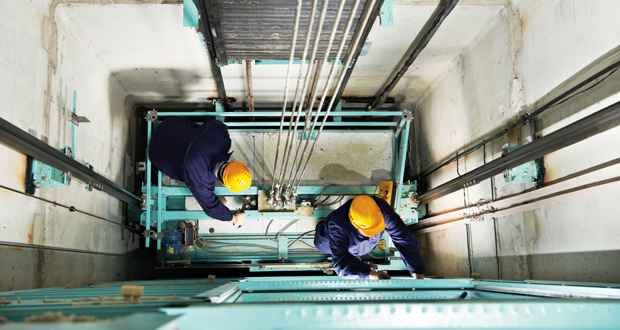
Lifts have always been a critical part of building operation and accessibility, but their role within fire strategies is becoming more prominent. They support evacuation planning, enable firefighter access and often form part of the wider building safety infrastructure. Yet responsibility for lifts is rarely held in one place. Design, maintenance, inspection and documentation are typically distributed across multiple contractors and stakeholders, each with their own systems, priorities and processes.
In the past, this fragmentation was less visible. Today, it must be actively managed and clearly demonstrated.
NO COMPLIANCE WITHOUT CLARITY
Our recent research highlights the extent of this challenge. It found that 44 per cent of FMs remain uncertain around their obligations under the Building Safety Act and nearly half (47 per cent) of FMs say that the industry suffers from fragmented and inconsistent record-keeping. These are not marginal concerns: they point to a broader issue around how compliance is understood and evidenced in day-to-day building management.
In many buildings, lift service records may sit with maintenance contractors, technical specifications with manufacturers, and upgrade histories with managing agents or consultants. Over time, this creates a patchwork of information that is difficult to access, verify, or interpret consistently.
The concept of a “golden thread” is intended to address this by ensuring that safety information is accurate, accessible and up to date. But in practice, maintaining that thread across lift systems can be challenging. Where records are incomplete or inconsistent, duty holders are left without a clear line of sight into system performance, even where the work itself has been carried out correctly.
In higher-risk or more complex buildings, this lack of visibility has wider implications because lifts don’t operate in isolation; they form part of
an integrated fire strategy. If information about those systems is not aligned with wider building data, it becomes more difficult to assess how risks interact, or to demonstrate that they are being effectively managed.
THE RETROFIT ENVIRONMENT
Historically, lift safety has been viewed primarily through a maintenance lens. If systems were regularly serviced and tested, they were considered compliant. While this remains an essential foundation, it is no longer sufficient alone. Compliance now extends to how systems are specified, how responsibilities are defined, and how information is shared across the supply chain.
Adding to this complexity, many facilities teams are now working within buildings that were never designed to meet current fire safety expectations. Therefore, upgrading lift systems often involves navigating physical constraints, legacy infrastructure and competing priorities across the estate. As a result, retrofitting to modern standards is rarely straightforward, particularly where lift shafts, power supplies or control systems limit what can be achieved.
Delivering compliant outcomes often requires input from multiple parties, including lift specialists, fire engineers, managing agents and contractors. Each brings a different perspective, but without clear alignment, there is a risk that decisions are made in isolation rather than as part of a coherent strategy, which is where gaps emerge and risks can increase. This means that adopting a more joined-up approach to lift management is essential.
ACTIVITY TO ASSURANCE
What is striking about our research is that regulatory uncertainty exists alongside strong operational performance. Inspections are being carried out regularly, maintenance regimes are in place, and there is widespread confidence in how buildings would respond in an emergency. This shows that the issue is not a lack of action, but that the systems used to coordinate, record and demonstrate it have not kept pace with regulatory expectations.
Centralising information is a key solution to this, but it is only effective if it is supported by clear ownership and consistent processes. FMs need visibility not just of what has been done, but of how and why decisions have been made. This includes understanding how lift systems interact with wider fire strategies and ensuring that any upgrades are properly documented.
In this context, engagement with specialist partners is critical. Lift systems are highly technical, and their role within fire safety is often nuanced. Therefore, bringing in expertise at an early stage, particularly when reviewing strategies or planning upgrades, can help to identify risks that may not be immediately visible and ensure that solutions are both practical and compliant.
ENSURING ALIGNMENT
Ultimately, the challenge for facilities managers is not a lack of activity, but a lack of alignment.
The industry has reached a point where operational diligence alone is no longer enough. What is needed now is clearer connection between the work being carried out on the ground and the regulatory frameworks that sit around it. This means reducing fragmentation, improving visibility, and ensuring that all parties involved in lift systems are working toward a shared understanding of compliance.
For FMs, compliance can no longer be assumed, it must be clearly demonstrated. For the broader industry, it’s not about entirely new processes, but about better collaboration to strengthen our existing ones.
Because in the current landscape, assurance depends not just on what is done, but on how well it is understood, recorded and shared.
And that cannot be achieved in silos.
In association with www.pewelectrical.com