 FMJ Facilities Management magazine providing industry-specific intelligence to FM and property professionals


 Paul Rankin, Director of Fire and Aviation at Securitas UK, explains why fire safety must be built into a business’ DNA and why facilities managers are central to achieving that
Fire risk assessments often sit quietly in the background of business operations. On the surface, it can feel like everything is already covered: the fire alarm is tested, the risk assessment is neatly filed away, and a few extinguishers are placed where everyone can see them. It all gives the impression that the essentials are in place. But when fire protection slips into a routine tick box exercise rather than a living, active priority, organisations can overlook the very risks most likely to cause real harm.
Fires cost UK businesses around £12 billion every year, which averages over £650,000 per incident. Behind these numbers are halted operations, damaged reputations, lost livelihoods and in the worst cases, serious risks to human life. Crucially, fire does not discriminate by building size or sector. A small office can be just as vulnerable as a sprawling industrial site, and for smaller businesses, the financial shock of a single incident can be impossible to recover from. Often, the common factor is a failure to recognise risk or act on it in time – a gap that proactive facilities managers can bridge.
What often triggers a fire isn’t a dramatic ignition event, but a seemingly unremarkable issue: A kettle that’s on the blink. Ageing electrical systems. Overheating equipment. A cigarette disposed of carelessly. And when you add in factors like a fire exit temporarily used to store deliveries, or a fire door wedged open “just for a moment” to improve ventilation, the risks escalate further.
This is why fire safety needs to be rooted in daily habits, not annual, or even monthly or weekly checks. And it is exactly why facilities managers sit at the heart of a robust fire strategy. They are the people who understand not just the fabric of a building, but the way the building is used.
FIRE RISK ASSESSMENTS
A fire risk assessment is designed to identify hazards, anticipate how they may cause harm, and outline how risks can be controlled. Yet too often, once completed, it may be filed away, only revisited when the renewal reminder appears.
But conditions change constantly. People introduce new equipment. Contractors carry out work that affects fire compartmentation. Storage slowly creeps into prohibited spaces. Even seasonal weather can influence fire behaviour within a building.
A risk assessment that is not actively applied, reviewed and embedded offers little more than administrative reassurance. What matters far more is how the findings of the assessment shape day to day operations, and whether the culture around fire safety encourages people to act on risks the moment they appear.
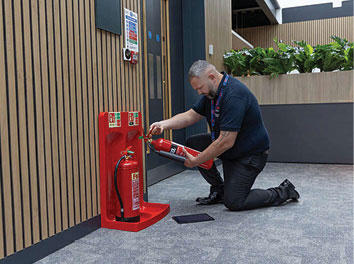 FMs are vital. They are the people most able to understand whether fire procedures are practical, whether staff can realistically follow them, and whether conditions within the workplace genuinely reflect what the paperwork claims.
THE FM ADVANTAGE
FMs play a unique role within a business. While many departments operate within their own remit, FMs are naturally integrated into every facet. They see how teams use spaces, where bottlenecks form, and where issues quietly emerge.
Their strength lies not just in their technical knowledge, but in their proximity to the everyday. They are present often enough to notice the small but telling details: a crack in an electrical socket, a fire door that no longer closes properly, an extraction system not performing as it should, or a piece of equipment running hot. These can be early warning signs that prevent a major incident.
And while facilities managers may not see themselves as “fire specialists,” they are often the first to recognise when a situation doesn’t look right. Their intuition about the building gives them a level of situational awareness that few others can replicate.
CULTURE CHANGE
Ultimately, the most effective fire safety strategies are not defined by checkboxes on an audit sheet. They are defined by culture, a workplace where people understand their responsibility, whether that means reporting a hazard, keeping routes clear, or following evacuation procedures without hesitation.
Cultivating this culture requires more than an annual briefing. It involves training that resonates, drills that reflect real scenarios, communication that is open and continuous, and a sense of shared accountability. Facilities managers play a crucial role in fostering this environment, not through enforcement, but through guidance, leadership and presence. Their involvement normalises fire awareness, helping staff understand that their choices matter.
PREVENTION PROTECTS
The difference between a close call and a catastrophe often comes down to two things: vigilance and preparedness. FMs, with their hands-on knowledge and day to day oversight, are uniquely positioned to influence both. By embedding fire safety into the behaviour of the organisation – not just its documentation – they help businesses protect their people, their operations and their future.
And when facilities managers lead the way, the entire organisation becomes safer, stronger and far more resilient.