 FMJ Facilities Management magazine providing industry-specific intelligence to FM and property professionals
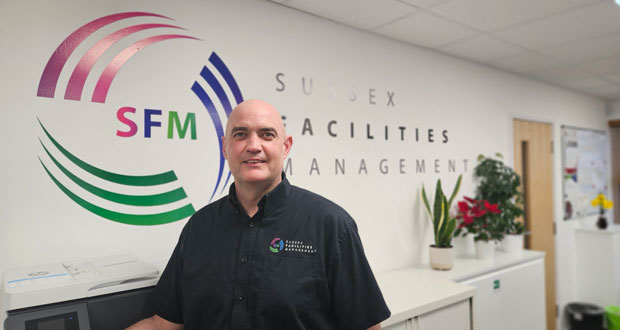
Sussex Facilities Management MD and Co-founder Mark Jackson on why Pope Leo XIV’s encyclical on AI mirrors the question every FM leader now faces – who decides what role AI plays in a business built on trust
I didn’t expect to find myself nodding along to a papal encyclical. But when Pope Leo XIV published Magnifica Humanitas, his recent document on artificial intelligence, a fair amount of it landed exactly where I’ve been sitting for the past couple of years: in the boardroom of a facilities management company, trying to work out what AI should and shouldn’t be allowed to do in a people business built on trust.
The encyclical garnered attention the world over. Alastair Campbell and Rory Stewart gave it a full episode of The Rest Is Politics, debating whether it was the most serious contribution to the AI debate so far and whether the Pope is doing more to hold Silicon Valley to account than any government.
Two of the points they kept returning to are the same two that have stuck with me. The first is the warning that a ‘more moral’ AI means very little if that morality gets decided by a handful of corporations and governments rather than negotiated more widely.
That’s precisely the worry I have when I think about guardrails quietly being loosened under commercial pressure. The second is the argument that work is worth more than the income it provides – that it gives people purpose, relationships, a stake in their community. Mass job losses to AI would be a cost in themselves, not just an economic problem you can paper over with compensation.
I see AI in our future as a positive force, with the right policies and controls in place, in work and in everyday life. What worries me is whether those guardrails will survive the pressure that big tech and some governments are quite capable of applying.
Putting people first
Facilities management is, at its heart, a people business. It depends on being responsive, relational and trusted – qualities that don’t show up neatly on a spec sheet. So the question for us was never really whether to bring AI in. It was who gets to decide what role it plays and what values shape that decision.
We ended up writing our own test for it. We see AI as a tool to amplify human excellence, not replace it. So we adopt it selectively, where it enhances relationships, simplifies delivery and improves outcomes for our clients. If a tool passes that test against our core values, only then does it move forward to a conversation with the wider team about what it might mean for the company.
We’re still early in that process. Day to day we’re leaning on tools like Microsoft Copilot and ChatGPT, with a handful of new AI-based solutions due to be trialled shortly. But I expect the boring parts of my job – and everyone else’s – to shrink. The administrative grind should increasingly need less of our direct input, freeing up time for more productive work without anyone working longer or harder to get there.
What’s left, once the boring bits are gone, is what actually matters. The value of a human becomes even greater. I suspect the novelty of technology for technology’s sake will fade in the way email or spreadsheets did before.
Take something as routine as a reactive maintenance request. AI can triage it, schedule it and order the parts faster than any of us. But when something goes wrong on a client’s site at 7am, they don’t want a chatbot – they want a named person who knows their building, picks up the phone and turns up. The same logic holds well beyond the office, for something as ordinary as a yoga class. I wouldn’t want a robot instructor. I’d want a human who carries the same constraints as the rest of us – with their bodies, their minds, their stresses, their lives.
It’s a trust issue
That instinct holds up commercially, too. LinkedIn’s 2025 B2B Marketing Benchmark found that 94 per cent of B2B marketers say trust drives every deal and decision, and the Superpowers Index 2025, drawn from more than 16,000 interviews across 21 markets, named trust as the single biggest factor in winning new business.
Face-to-face meetings close at around 40 per cent, well above digital averages, and almost everyone surveyed said in-person contact builds stronger relationships than dealing with someone online. At the same time, trustworthiness of AI systems has decreased from 63 per cent in 2022 to 56 per cent in 2024, with worry rising from 49 per cent to 62 per cent over the same period.
In a region like Sussex and the wider South East, where business still gets done on handshakes and local reputation and simply turning up when it matters, I think that combination – cautious, values-led AI adoption alongside a renewed premium on actual human contact – is the right one for us.
Campbell and Stewart sketched out four camps in the wider debate on that podcast: resigned fatalism that nothing can be done, trusting tech firms to regulate themselves while they race each other, the Pope’s preference for shaping AI through democratic and international institutions, or hoping the US and China can be persuaded to slow down together. Both hosts said they leaned towards the Pope’s camp, while admitting the international bodies that would need to do that shaping are weaker than they’ve been in decades.
My own instincts sit in similar territory. Our test for any new AI tool at SFM – does it pass against our core values before it even reaches a conversation with the wider team – is, in miniature, the same bet. That AI is better shaped by shared values and wider scrutiny than left to whoever moves fastest.
My hope is that AI’s capacity to strip away human interaction will end up having the opposite effect – that it will push people to value connection and community more, not less.